The rich tapestry of China’s history is marked by the influential reigns of its dynasties, each employing distinctive government systems that shaped its society and political landscape. Through the ebb and flow of power, Chinese dynasties demonstrated the ability to adapt and restructure their governance, fostering development over time. This adaptation was not only a response to internal pressures but also a representation of the philosophies and ideologies that guided their rule. The pillars of traditional Chinese governance—as evidenced through the Mandate of Heaven, Confucianism, and the intricacies of feudal hierarchy—coupled with the dynasties’ keenness to evolve administratively, laid the foundation for a unique legacy that resonates throughout Chinese history.
Foundations and Philosophies Influencing Early Dynastic Governance
The Mandate of Heaven: Divine Justification for Imperial Rule
Confucianism and its Impact on Bureaucratic Hierarchy
The Hierarchal Structure of Feudal Dynasty Rule
Key Takeaways
- Understanding the Mandate of Heaven is vital for grasping the justification of power in Chinese dynasties.
- Confucianism profoundly influenced the bureaucracy, weaving a moral code into the governance structure.
- The early Chinese dynasties structured society with a rigid feudal hierarchy that determined political and military control.
- The evolution of governmental systems in Chinese dynasties reflects adaptation to the changing demands of ruling vast and diverse territories.
- Historic philosophical inputs like Confucian ideals have left an indelible mark on the governance practices of subsequent generations.
Foundations and Philosophies Influencing Early Dynastic Governance
The historical scaffoldings of China’s storied past are deeply rooted in the intricate interplay between divine right and philosophical teachings. Embedded within the fabric of early dynastic governance, these elements collectively shaped the political and social landscapes that governed ancient Chinese society. The Mandate of Heaven and Confucianism were more than mere concepts; they were the lifeblood that sustained the hierarchical structures of feudal dynasty rule, echoing through the corridors of power and laying the foundations for centuries of imperial leadership.
The Mandate of Heaven: Divine Justification for Imperial Rule
At the zenith of Chinese theocracy, the Mandate of Heaven reigned supreme – an ancient political doctrine that granted emperors a celestial seal of approval, a divine simile for their earthly governance. This ethereal endorsement provided a dual purpose: bestowing legitimacy to those who ruled while casting down those who faltered, framing the cyclical nature of rise and fall in stark celestial terms.
Confucianism and its Impact on Bureaucratic Hierarchy
Flowing from the pen of Kong Fuzi, known in the West as Confucius, Confucianism emerged as the philosophical cornerstone of imperial bureaucracy. It promulgated a governance model steeped in moral rectitude and social order, where Confucian scholars became the architects of policy and the arbiters of ethics, intricately weaving their teachings into the tapestry of political life.
The Hierarchal Structure of Feudal Dynasty Rule
Amidst the echelons of power, the stratified layers of feudal dynasty rule carved society into a lattice of ranks and responsibilities. At its pinnacle sat the emperor, a figure of near-mythical sovereignty, while a network of vassals and local lords managed their dominions, each a cog in the grand machination of the dynasty’s power distribution. This system echoed the Confucian emphasis on rightful place and order, reinforcing the status quo that underscored an era of rulership.
The interconnectivity between heaven, philosophy, and feudalism was more than a scaffold for power; it was an ideology that permeated every facet of ancient Chinese life, from the peasant in the field to the emperor on the dragon throne. Together, they forged a legacy of governance that resonated through the annals of history, informing modern interpretations of power, righteousness, and the human condition.
Explain the systems of government employed by Chinese dynasties
The complex tapestry of Chinese history is marked by profound bureaucratic advancements that underpinned governance across dynastic reigns. The evolution of bureaucracy was an ongoing process, characterized by incremental reforms aimed at improving the efficiency and structure of the civil service. Particularly notable was the transformation from the initial trio of departments to an intricate six-ministry framework, which significantly enhanced the administrative capabilities of the state.
The Evolution of Bureaucracy: From Three Departments to Six Ministries
Historically, China’s administrative landscape witnessed a pivotal shift as the three-department system blossomed into a well-organized establishment comprising six ministries. This reorganization laid the groundwork for a more stratified government, which could delegate specialized functions to distinct administrative organs, hence endorsing the meritocracy that began to characterize the imperial service.
The Standardization of Administration: Unification under the Imperial Examination
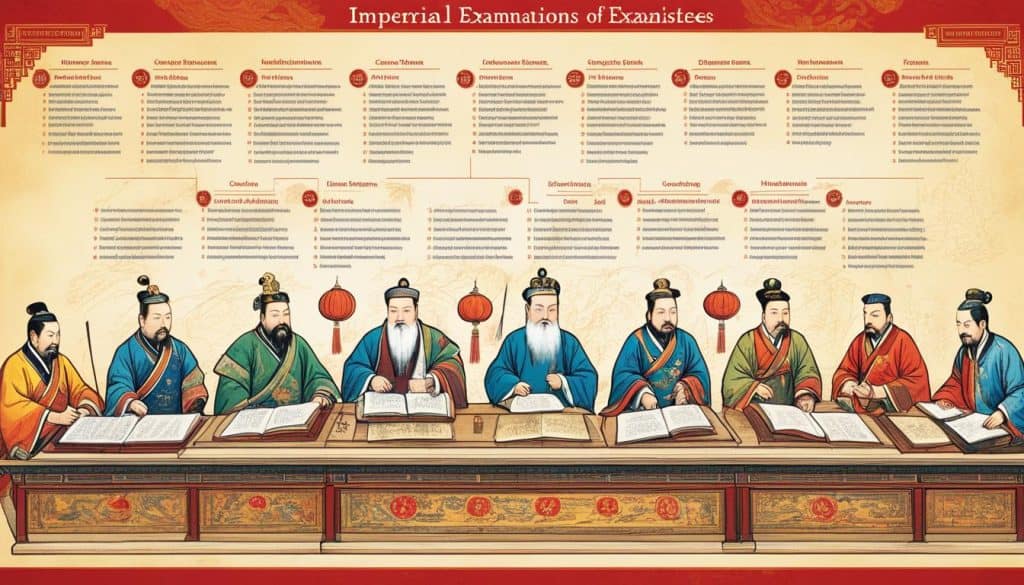
Integral to the standardization of administration was the institutionalization of the Imperial Examination, a transformative approach that sought to homogenize governance practices across the vast Chinese empire. The examination was central to forming a competent bureaucracy guided by the values enshrined in Confucian ethics, ensuring that civil servants were selected for their intellectual prowess and moral rectitude rather than their aristocratic lineage.
Civil Service and Meritocracy: The Song Dynasty’s Keju System
During the Song Dynasty, the introduction of the Keju System marked a definitive move towards a merit-based civil service. Pioneering the notions of upward mobility and equitable opportunity, the Keju System underscored the essence of meritocracy in public service. It supplied a conduit for the capable, irrespective of their background, to contribute to the administrative functions of the state, thereby encapsulating the very spirit of an evolved bureaucracy.
As we delve deeper into the bastion of Chinese bureaucracy, one cannot help but marvel at the precision with which the systems of governance were sculpted to cultivate an enduring legacy of administrative competence and ethical leadership. From the foundational reforms of the three departments to the nuanced complexities of the six ministries, the undeniable thread throughout the ages has been the relentless pursuit of standardization of administration and institutionalized meritocracy, hallmarks of a governance model that continues to inspire even in contemporary discourse.
The Ascendancy of Autocratic Rule and Its Centralization In Ancient China
The evolution of governance in ancient China marked a distinctive shift toward autocratic rule, forging a path where the echelons of power increasingly moved towards the emperor and their close advisors. This prevalence of autocracy redesigned the political tapestry of the nation, underscoring a robust centralization of authority. The emperors of ancient China, ruling under the autocratic regime, assumed control over critical aspects of governance, such as military operations, fiscal policies, and the enforcement of laws. This concentration of power proved to be a double-edged sword. It facilitated a streamlined decision-making process, enabling swift and coherent implementation of policies.
However, the rise in autocratic tendencies also heightened the potential for unchecked authority and the pitfalls associated with it. The centralization of governance in ancient China brought efficiency but at the steep cost of fostering a system that could indulge in authoritarian excesses and the abuse of power. The historical narrative of centralization in ancient Chinese governance serves as a testament to the complex dynamics of political power and its impact on society.
| Aspect of Governance | Pre-Autocratic Rule | Post-Autocratic Rule |
|---|---|---|
| Military Affairs | Distributed authority | Centralized imperial control |
| Taxation | Regional variations | Standardized by central decree |
| Law Enforcement | Largely local jurisdiction | Imperial codes and enforcement |
| Policymaking | Collective noble input | Imperial edicts |
| Public Administration | Feudal management | Centralized bureaucracy |
The structural changes in ancient China‘s administration not only reflect the paradigm shift in political thought but also delineate the contours of governmental evolution—a narrative that showcases the transformative effects of autocratic rule and centralization.

Impacts of Foreign Influence and Military Affairs on Dynastic Authority
The tapestry of Chinese history is richly woven with threads of interactions with foreign powers, each leaving a distinct imprint on the fabric of dynastic authority. Notably, the leveraging of military affairs as a tool to establish and assert dominance often came with consequences that extended beyond borders, influencing governance and the ruling class’s grip on power. Striking a balance between defense and diplomacy was paramount to a dynasty’s survival, with the tribute system providing a nuanced approach to managing international relations.
Through fluctuations in military prowess and diplomatic engagement, foreign influence on Chinese dynasties was unmistakable. The tribute system, for instance, was not merely a ceremonial practice but a form of soft power that enmeshed China with other civilizations through an intricate network of reciprocal obligations. This system, reflecting the might and reach of the Central Kingdom, also demanded acquiescence from neighboring territories, solidifying China’s stature and contributing to the geopolitical landscape that defined dynastic authority.
The sword and the scroll worked in concert to erect and preserve empires. Security concerns and ambition-driven campaigns led to offensive and defensive maneuvers that could either enhance a dynasty’s standing or diminish its legacy. The resonance of victories and the echoes of defeats in military affairs were pivotal, potentially swaying public perception and altering the course of history. Consequently, the cumulative impact of wars, strategic alliances, and military innovation played critical roles in the evolution and eventual fate of China’s dynastic lineages.