
The Roman governance system has profoundly influenced the formation and evolution of modern American political systems. The hallmarks of ancient Rome’s legacy are embedded within the core principles and structures of the United States government. From its early inception, the American republic drew inspiration from Rome’s institutional designs, embedding concepts such as the rule of law, separation of powers, and checks and balances into its Constitution and broader political framework. The impact of Rome on American government is evident in the architecture of governance, where Roman ideas provide the bedrock upon which the United States has built and continues to refine its democratic institutions.
Key Takeaways
- Roman governance established a blueprint for modern American political systems.
- Concepts like the rule of law and separation of powers are rooted in Roman legacies.
- The structure of the American government reflects Roman republican influence.
- Rome has left a significant mark on the design and function of U.S. political institutions.
- The architecture of American governance continues to draw upon Roman ideals and practices.
The Historical Foundations of American Democracy: Greek and Roman Contributions
The bedrock of the American democratic system is often traced back to classical antiquity, drawing from profound Greek contributions to democracy, and the Roman republic. The founding fathers of the United States actively engaged with the principles and structures of these ancient civilizations to inform the blueprint of the American government. Moreover, the architectural influences from Rome on US government buildings are as much a symbolic as a physical testament to this rich legacy.
Ancient Greek Contributions to Modern Democratic Ideas
The genesis of democratic ideas can be unearthed in the ancient city-state of Athens. Pioneering the concept of citizens’ participation in governance, the Greeks established the foundational norms that find resonance today. Ideas such as free speech, majority rule, and civic responsibility were incubated here and later adopted and adapted by American democracy to form a government ‘of the people, by the people, for the people’.
Roman Republican Structure and American Government Design
The Roman republic, with its foundational tenets of a representative government and the separation of powers, provided a critical framework that shaped the institutional design of the American government. This republicanism championed the ideals of mixed government theory, which advocated for the inclusion of monarchical, aristocratic, and democratic elements—a model that impressed upon the structure of the executive, legislative, and judiciary branches in the United States.
Architectural Echoes: From Roman Temples to U.S. Government Buildings
Roman architectural splendor has inspired the designs of many US government buildings, embedding the classical principles that exude grandeur, durability, and authority. The quintessential example of this inspiration is the United States Capitol, which evokes the essence of Roman temples with its dome and columnar presence. It stands as an arresting visual representation of a nation that not only admired Rome’s political wisdom but also aspired to mirror its monumental aesthetics.
These historic threads that connect ancient Greece and Rome to the American democratic fabric demonstrate that the United States, while unique in its character, is indebted in its origins to the Mediterranean cradle of western civil society. As we inhabit contemporary structures and engage with modern governance, it becomes invaluable to understand and appreciate this lineage that has shaped, and continues to enrich, our civil and political landscape.
How Did Rome Influence American Government
The architectural and political frameworks of ancient Rome have cast a long shadow over modern America’s development. Notably, their ingenuity has travelled through time, solidifying its place as a cornerstone of American governance and jurisprudence. Let us excavate the layers of this historical legacy to comprehend the magnitude of Rome’s influence.
The Concept of Checks and Balances: A Roman Legacy
The influence of Rome on American government is perhaps nowhere more evident than in the principle of checks and balances, a system designed to prevent any one branch from accruing too much power. This concept, a checks and balances legacy, has its ancestry in the Roman Republic, where the separation of powers between consuls, the senate, and the assemblies provided a form of mutual oversight. The Framers of the American Constitution ingeniously adapted this Roman blueprint to forge a government capable of self-regulation and balance.
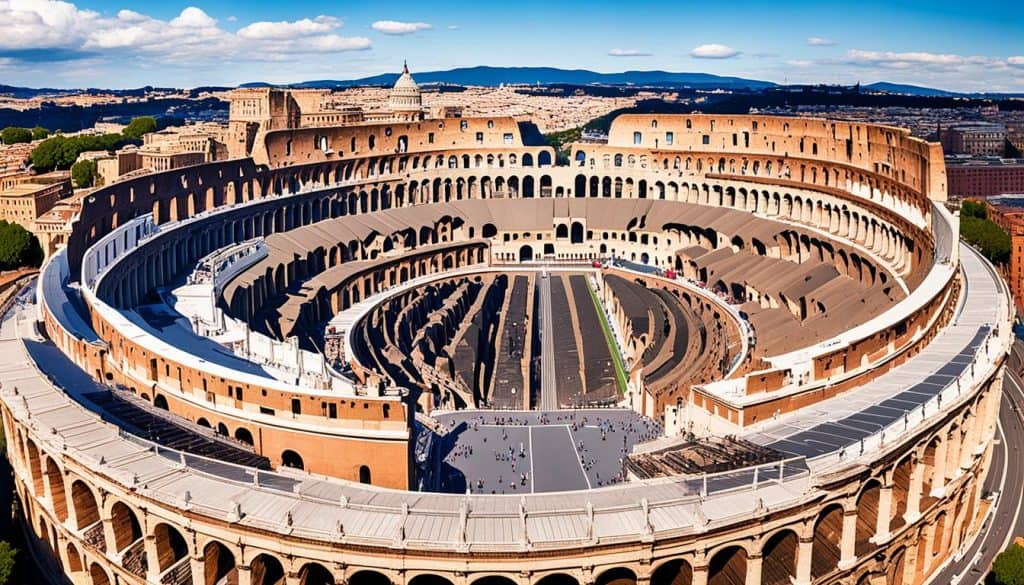
The Senate and Its Transformation Across Cultures
The evolution of the Senate, as witnessed in American political organization, takes its cue from the Roman Senate – an institution that has been replicated and reinterpreted through the ages. In ancient Rome, the Senate wielded tremendous advisory capacity, shaping the republic’s policies and imperial pursuits. The American Senate, although having evolved in its functions and powers, preserves the legacy of its Roman predecessor as a pivotal legislative body, reflecting on the evolution of the Senate from an advisory council to a fundamental piece of the puzzle in law-making and governance.
Rule of Law: An Eternal Principle Passed Down from Rome
Rome’s greatest bequest to the modern world arguably lies in the concept of the rule of law from Rome. Roman legal system’s emphasis on codified laws that apply equally to all citizens set the groundwork for what would become a foundational pillar of American jurisprudence. The Roman articulation of natural law and justice as prevailing over the whims of rulers is echoed in America’s commitment to the constitution and the impartiality of the judiciary—enshrining the rule of law as an immutable principle within society.
Comparative Lessons: Ancient Rome’s Lasting Impact on U.S. Institutions
As the chapters of history unfurl, it becomes unmistakably clear that the governance and organizational structure of the United States owes a substantial debt to the venerable traditions of ancient Rome. Delving into the intricacies of Rome’s impact on US institutions reveals a tapestry woven with threads of political wisdom and administrative foresight. The architectural grandeur and design of U.S. government buildings is just the superficial layer hiding the deep-seated structural and operational influences that have transcended time and geography to arrive at the heart of modern-day America.
One cannot overlook the profound lessons from ancient Rome that have been adapted and adopted within the fabric of American governance. Rome taught us that civic virtue and the active participation of citizens in public affairs are cardinal to the health and longevity of a state. This lesson is mirrored in the way Americans are encouraged and expected to engage in civic duties, including voting and jury service. The Roman influence extends to the principles of governance as well— the sophisticated Roman system of checks and balances is echoed in the intricacies of the U.S. federal government, ensuring no single branch acquires uncontested power.
The enduring legacy of Rome in America is further immortalized through the institutions that form the backbone of American political life. The Roman Senate, an assembly whose decisions wielded considerable influence over the republic, is conceptually immortalized in the U.S. Senate—a body that stands pivotal in the legislative process. Moreover, the legal frameworks that guide countless facets of American life are similarly rooted in Roman law, designed with a foresight that has allowed them to endure the changing tides of societal evolution. In conclusion, the canvas of American governance is shaded deeply with the hues of Roman legacy, serving as a timeless mentor for governance and societal structure in the contemporary era.