The Song Dynasty, a beacon of governance in Chinese history, mastered the art of political continuity through its well-structured imperial bureaucracy. This bureaucracy enabled the Song rulers, from 960 to 1279, to maintain order and continuity in the nation’s administrative affairs. Striking a balance between innovation and tradition, the Song Dynasty’s imperial bureaucracy was a sophisticated network that streamlined governance and reinforced the empire’s ideological framework. This allowed for not only a smooth transition of power but also the preservation of administrative structures, keeping the core principles and practices steady across generations.
Key Takeaways
- The Song Dynasty’s imperial bureaucracy ensured political continuity through a merit-based governance system.
- Innovative yet rooted in tradition, the Song Dynasty balanced new methodologies with established principles.
- By institutionalizing civil service exams, the bureaucracy fostered meritocracy and competence.
- Maintaining administrative roles and functions contributed to the dynasty’s stable governance.
- Confucian ideals remained at the heart of the Song Dynasty bureaucracy, shaping its ethical framework.
- The bureaucracy’s success lay in its ability to adapt while preserving the essence of its past.
The Institutional Framework of Song Dynasty Bureaucracy
The Song Dynasty is renowned for its advanced governmental structures, which have had a lasting influence on future generations. One of the most pivotal components of the Song Dynasty Bureaucracy was its robust institutional framework. At the heart of this structure was the Civil Service Examination, an innovative approach to fostering Meritocracy within the dynasty’s administrative system.
The Civil Service Examination and Meritocracy
The introduction of the Civil Service Examination system marked a significant shift towards merit-based appointment in the Song Dynasty Bureaucracy. This approach fortified Meritocracy, allowing individuals to rise through the governmental ranks based on intellectual prowess and ability, rather than lineage or wealth. The competitive exams, steeped in Confucian Ideals, tested candidates on a variety of subjects, ensuring that only the most capable minds were selected for bureaucratic roles.
Persistence of Bureaucratic Roles and Functions
The Bureaucratic Roles and Administrative Functions established by the dynasty were integral to its administration and contributed significantly to its political continuity. These roles encompassed a multitude of responsibilities, including tax collection, resource management, and public service delivery, and were instrumental in the effective governance across the vast empire.
| Bureaucratic Role | Main Function | Associated Confucian Value |
|---|---|---|
| Tax Collector | Revenue Management | Integrity |
| Resource Manager | Allocation of State Resources | Wisdom |
| Law Enforcement Official | Upholding Legal Order | Fairness |
| Public Services Coordinator | Implementation of Policies for Public Welfare | Compassion |
Continuation of Confucian Ideals in Governance
Confucian Ideals were deeply woven into the fabric of the dynasty’s governance, ensuring the continuation of ethical and moral values within the political system. The imperatives of righteousness, proper conduct, and the pursuit of social harmony informed decision-making processes, reflecting the profound influence of Confucian teachings on the Song Dynasty Bureaucracy.
Governance within the Song era, thus, was not just an administrative endeavor but also a reflection of a deeply moralistic world-view that aimed to create a balanced and equitable society in line with ancient philosophical tenets.
The Role of Bureaucrats in Maintaining Social Harmony
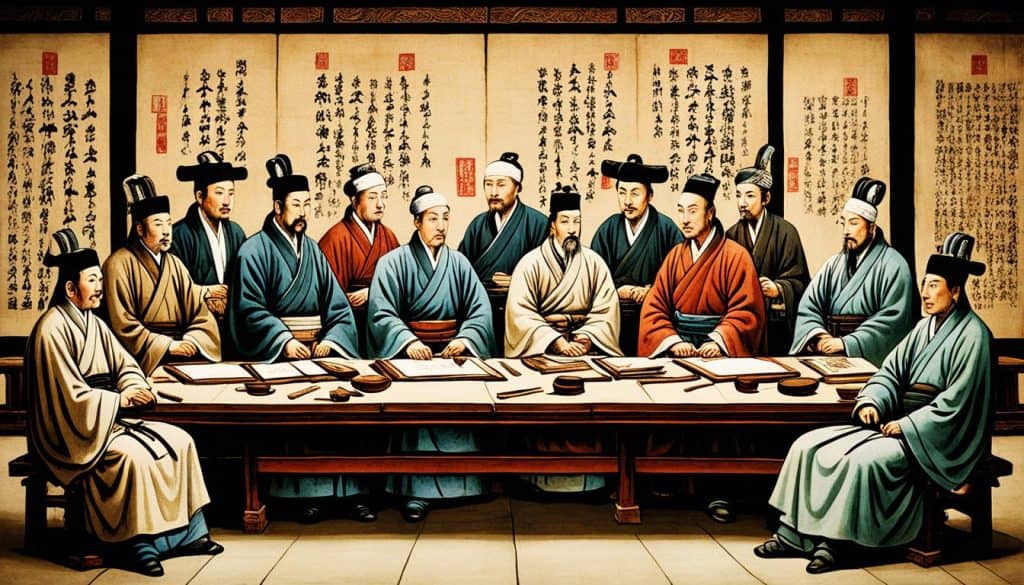
The Song Dynasty was a period of exceptional governance, much of which hinged on the activities of the bureaucrats. Tasked with upholding law and order, these officials exerted substantial influence in reinforcing social harmony throughout this historic period. Understanding the importance of these bureaucrats necessitates a closer examination of their roles and the systems they managed to maintain stability and prosperity in the dynasty.
As mediators and enforcers, bureaucrats had a direct hand in resolving conflicts that could potentially disrupt the peace. Their commitment to fairness and justice wasn’t merely a professional obligation; it represented a deep-rooted ideological stance informed by the prevailing Confucian ethos of the era. They were trained to provide equitable solutions further cementing the Song Dynasty’s reputation for fairness and establishing a lasting legacy of structured and effective governance.
Their responsibilities extended beyond conflict resolution and touched on every aspect of civil life that required regulation and foresight. Moreover, these bureaucrats served as the nexus between the imperial court and the common populace, ensuring that the interests and wellbeing of the citizens were represented, all while forwarding the directives of the ruling authority. This delicate balancing act facilitated a level of social cohesion that became synonymous with the Song Dynasty era.
- Maintenance of legal order
- Mediation of public disputes
- Implementation of economic policies
- Safeguarding of public works
- Education and public morality campaigns
To illustrate the multi-faceted role of these crucial figures during the Song Dynasty, consider the following table which offers insight into the various areas where bureaucrats had a significant impact:
| Area of Influence | Role of Bureaucrats | Impact on Social Harmony |
|---|---|---|
| Justice System | Fair adjudication of disputes | Reduced conflict and promoted fairness |
| Public Administration | Implementation and oversight of civil projects | Improved living conditions and public satisfaction |
| Fiscal Policy | Assessment and collection of taxes | Enabled redistribution and resource allocation |
| Cultural Affairs | Curation of educational initiatives | Perpetuation of cultural values and ideology |
In conclusion, when examining the sustaining powers behind the Song Dynasty, it’s clear that bureaucrats were more than administrative functionaries; they were the custodians of social harmony. Through their diligent work and Confucian-guided principles, they facilitated a golden era of Chinese history that remains influential to this day, underlying the importance of capable governance in the course of a civilization’s development.
How did the Song dynasty imperial bureaucracy represent a political continuity
The fabric of the Imperial Bureaucracy during the Song Dynasty period was woven intricately with principles that displayed remarkable political continuity. At its core, the establishment of a merit-based system was pivotal in fostering a stable governance structure that allowed the dynasty to thrive. The utilitarian approach to bureaucratic appointments, primarily through the civil service examination, marked a distinctive move towards a system where talent and knowledge triumphed over lineage and social status. This rigorous selection process curated a class of highly capable administrators who upheld the efficiency and continuity of the empire’s machinery.
In addition to their meritocratic ideology, the uninterrupted endurance of bureaucratic roles played a significant role in maintaining the Song Dynasty’s political continuity. With well-defined responsibilities ranging from tax collection to resource management, these roles were critical in carrying out the empire’s agenda in a consistent and orderly fashion. This constancy not only reinforced the administrative structure but also manifested a dependable governance experience for the populace, laying the foundation for an enduring imperial bureaucracy. The administrative functions were executed within the framework of Confucian ideals, which served as both the ethical compass and the cohesive bond, ensuring that the ruling ethos of the Song Dynasty prevailed through generations of bureaucrats.
The unwavering adherence to Confucian ideals was yet another aspect that fortified the principle of political continuity within the Song Dynasty’s imperial bureaucracy. By embedding these philosophical tenets into the core of governance, the dynasty aligned its political doctrine with enduring values such as moral righteousness, social harmony, and ethical governance. These values transcended time, creating a legacy that would cement the dynasty’s approach to governance for centuries. As a result, the continuity of the Song Dynasty’s unique form of governance stood as a testament to its visionary approach towards creating a balanced, stable, and enduring imperial bureaucracy, ensconcing it in the annals of history as a model of administrative sophistication and consistency.