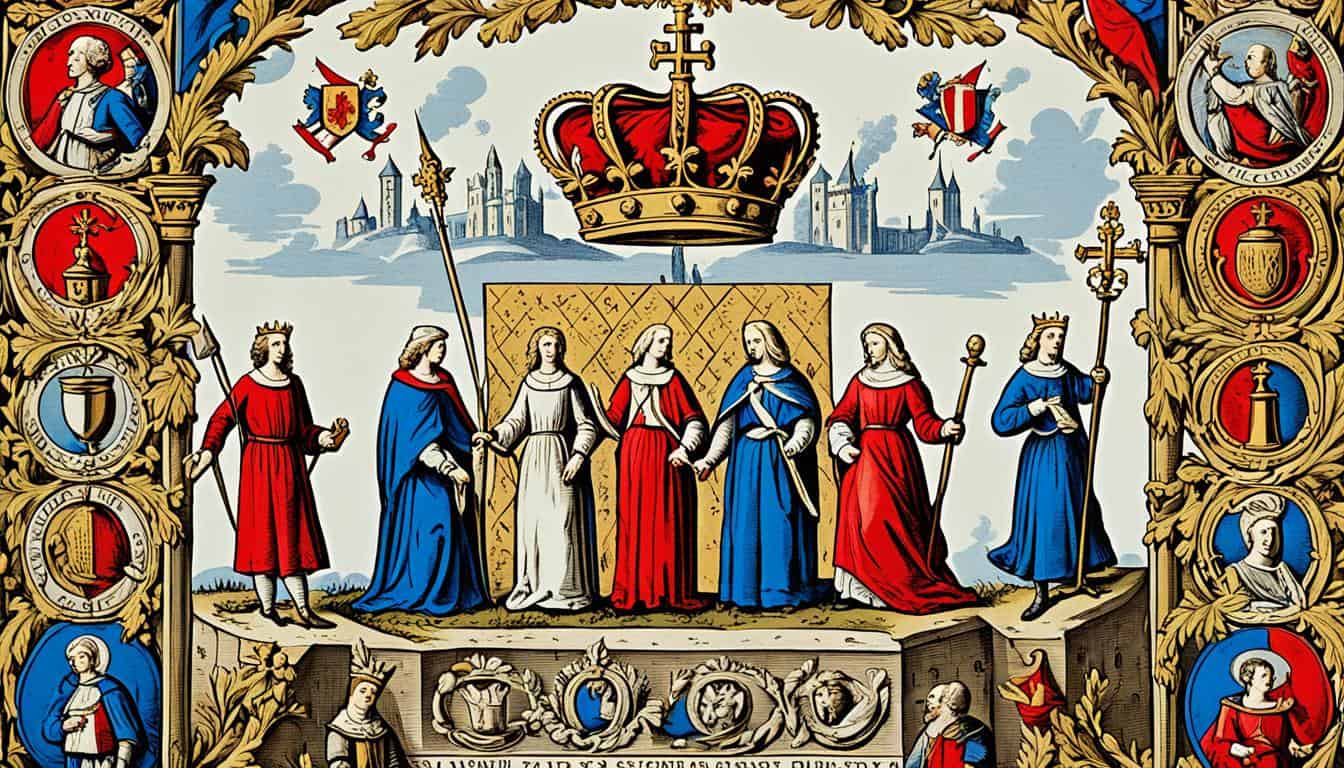
The formation and stability of any nation’s government are intricately linked to its historical doctrines and the philosophies of influential thinkers. In the context of the French government, one cannot overlook the profound impact Jean Domat, a reputable French jurist of Louis XIV’s reign, has had on the origins and framework of authority. Domat’s perspective on the establishment of French governance is carefully rooted in his interpretations of the law of nature and divine law, both central themes in his celebrated work, ‘Public Law’. This treatise offers an incisive analysis into how the intricate weave of society’s fabric aligns with broader divine ordinations, anointing the monarch as the earthly embodiment of God’s rule.
According to Domat, the king’s governing power is both an extension of natural law and a manifestation of God’s will. The inception of government, Domat argues, is thus not merely a human construction but a divine edict meant to uphold social order, equity, and the common good. His compelling articulation of societal roles and hierarchies under this framework casts a historical light on the origins of the French government, offering critical insights into its monarchical and hierarchical nature, hallmarked by the intersection of divine providence and terrestrial leadership.
The French government of yesteryears, as contended by Domat, was sculpted by divine hands where the sovereign’s scepter was both a symbol of power and a testament to divine intent, steering the societal rudder towards harmony and justice. Domat’s perspective thus becomes a crucial reference point when unraveling the rich tapestry of France’s political chronicles.
Key Takeaways
- Jean Domat’s work offers vital insights into the origins of French government as rooted in natural and divine law.
- The French monarch’s authority, as seen by Domat, is inherently divinely sanctioned, shaping the very establishment of governance.
- Understanding Domat’s perspective enriches the comprehension of the hierarchical structure of past French society and its reverberations in modern governance.
- Domat positions the king as the earthly representative of divine order, underscoring a direct link between God’s will and royal power.
- The contributions of Domat’s treatises extend beyond historical curiosity, affecting modern interpretations of law, authority, and social responsibilities.
The Foundation of French Royal Absolutism: Jean Domat’s Perspective
Delving into the bedrock of French royal absolutism necessitates an examination of the thoughts posited by Jean Domat, a jurist whose belief in the intrinsic connection between law and social structure has echoed through the annals of French history. Through Domat’s eyes, the tapestry of societal hierarchy and the concentration of monarchical power reveal a grand design, where every thread is meticulously positioned by none other than divine providence.
Domat’s View on Social Order and the Law of Nature
Domat’s perspective illuminates the concept that social order is not a human invention but rather entrenched in the law of nature, crafted and coveted by divine intentions. The assignation of varying roles and ranks is perceived as an underpinning truth of societal harmony, ensuring that justice prevails by preventing societal injustices brought upon by chaos.
The King’s Divine Right and Royal Authority
Within the framework of French royal absolutism, the king emerges not merely as a figurehead but as a manifest vessel of the divine right. Domat argues, fervently, that royal authority and power flow directly from the font of divinity, making the monarch a tangible extension of God’s will on Earth, endowed with the right to command and the grace to guide.
The Role of God’s Will in Establishing Governmental Power
To comprehend governmental power from Domat’s perspective is to acknowledge the role of God’s will as the cornerstone of governance. It is through divine sanction that individuals are called upon to lead, to bear the mantle of authority, and ensure that the government’s judicious exercise of power aligns with the celestial blueprint for order and justice.
| Concept | Explanation as per Domat |
|---|---|
| Social Order | Rooted in the law of nature, reflecting a divine orchestration of roles and ranks. |
| Royal Authority | Derives legitimacy from divine right, the monarch acts as God’s earthly lieutenant. |
| Governmental Power | Founded and entrusted by God, its exercise is an embodiment of His will. |
In essence, French royal absolutism under Domat’s elucidation stands as a testament to an ordained social order, upheld by the divine right of kings and perpetuated through the will of God. It’s a structure of power that, in his view, legitimates the sovereign’s role as much more than a political leader—it is, decidedly, a sacred office etched into the very cosmos.
According to Domat, Who Established the Government of France?
Exploring the work of Jean Domat reveals a profound conviction that the establishment of the government of France was not merely a human endeavor, but rather a divine orchestration. Domat critically articulated this viewpoint, where the divine origins of authority ensure the common good is aligned with a higher moral purpose.
In his thorough examination, Domat argued that the fabric of society, including the distinct roles and relationships therein, were purposefully designed by God. From the intrinsic bond between parent and child to the intricate tapestry of professions, every aspect of societal structure hinted at the necessity for a ruling entity—a government to impose order and cohesion.
What follows is an informative table detailing the key components recognized by Domat as essential in the divine establishment of the government of France:
| Aspect | Explanation by Domat | Consequence for Society |
|---|---|---|
| Divine Design | Government’s foundation is attributed to God’s will. | Legitimizes authority and instills societal trust. |
| Common Good | Government purposed for the overall well-being of society. | Encourages cooperation and commonality of societal goals. |
| Roles and Responsibilities | God designed society with a natural order and hierarchy. | Clarifies societal functions and promotes orderliness. |
| Governing Authority | Leaders are divinely ordained to serve and govern. | Provides structure and authority within the community. |
Domat’s approach to the government of France intertwines theological reasoning with practical governance, highlighting that the establishment and function of government is beyond mere human construction but is an expression of divine will for the prosperity and soundness of society.

Domat’s Doctrine: The King’s Providential Mandate and Public Good
Within the intricate tapestry of historical jurisprudence, Domat’s doctrine plays a pivotal role in articulating a monarch’s divine authority. This philosophy established a precedent for monarchical obedience, harmonizing the societal fabric with a sense of orderly conduct and unwavering reverence towards the crown. The concept of the king’s mandate thus emerges as not merely a right to rule, but as an indispensably sacred duty towards both divine will and the public good.
The Necessity of Monarchical Obedience for Social Harmony
The public good was paramount in Domat’s interpretation of social order, with the monarch’s governance seen as a reflection of society’s collective aspirations. Through the lens of the era, monarchical obedience represented more than fealty; it was the cornerstone of social harmony and the underpinning of a community aligned under a singular divine vision.
The Sovereign’s Duty to Reflect Divine Justice
The ruler’s actions, according to this doctrine, were to be a mirror of divine justice, ensuring equity and fair judgment prevailed across their realm. Domat’s writings endorse that a sovereign’s purpose was intrinsically linked to a higher moral compass, one that was expected to guide their decree with righteousness and benevolence.
Maintaining Royal Power Through Visible Splendor and Majesty
Lastly, the grandeur and ceremonial awe historically associated with monarchy are derived from Domat’s advisement on maintaining respect through visual representations of power. Such splendor, he asserted, reaffirmed the king’s mandate and legitimized the supremacy of their providential role. Displaying majesty wasn’t merely for extravagance—it served to perpetuate an image of strength and unity within the society.
| Concept | Interpretation According to Domat | Implication in Monarchical Governance |
|---|---|---|
| King’s Providential Mandate | Rule in accordance with God’s will | Central pillar to the kingdom’s ideology and justification for the monarch’s authority |
| Monarchical Obedience | Submission of the governed to the ruler | Ensures social order and reflects societal adherence to the divine order |
| Public Good | Ultimate aim of governance | Permeates every aspect of rule, prioritizing societal welfare and unity |
| Divine Justice | Reflection of God’s righteousness in judgments | Serves as the moral framework for the sovereign’s decisions |
| Visible Splendor and Majesty | Exhibition of royal power and authority | Cultivates respect and awe, reinforcing the monarch’s divine right to rule |
Responsibilities and Influence of the Governed in Domat’s Theory
Within the framework of Domat’s theory, the concept of communal harmony hinges on the foundations laid out by the governed. Their adherence to responsibilities is not a mere suggestion but a pivotal axis upon which public order rotates. Domat articulated the vision that for the mechanism of society to function seamlessly, each cog – each citizen – must align with the overarching principles of governance. This isn’t merely about obeying the laws that govern daily actions; it’s about a deeper social contract, one that includes not engaging in acts that undermine these laws, a concerted effort in executing tasks ascribed by society, and willingly embracing collective burdens.
These responsibilities are critical to the public good, an element significantly underscored in Domat’s discourse. The governed, consequently, wield considerable influence in shaping the societal structure by fulfilling their prescribed roles. The dynamic between the actions of individuals and the greater societal fabric are inextricably linked, where responsible behavior reinforces social order, and, conversely, individual transgressions can ripple into communal discord. Thus, the influence posited in Domat’s theory is a dual-edged sword, with the capacity to stabilize or unsettle the societal equilibrium.
The social landscape painted by Domat is one where each individual’s duties are not isolated acts but are an intrinsic part of a grander tapestry of communal existence. As such, the governed contribute to a thriving civil society not just through compliance but through active participation in the scaffolding of public order. Their influence is manifested in the daily enactment of these roles, embodying the spirit of Domat’s governance principles, where the collective impact of individual actions coalesces to form the robust structure of society itself.