The complex tapestry of governance throughout the history of Chinese dynasties is characterized by significant evolution and adaptation. These systems of government, initially rooted in the patriarchal structures of ancient clan societies, have transformed through centuries, with each dynasty refining and reimagining governance to suit the times. This intricate evolution is a product of philosophical, military, economic, and cultural revolutions, with each dynastic change leaving its unique stamp on the adminstrative landscape of China.
Focusing on how government systems were employed across different eras, we will unearth the progression and development that these structures underwent. Vital to understanding this historical journey is acknowledging the unique contributions and adaptations made by various dynastic rulers, from the establishment of bureaucracy to the integration of Confucian principles, leading to a governance system unlike any other in the world.
Key Takeaways
- Early government systems were based on ancient clan structures and were intensely patriarchal.
- Chinese dynasties have shown a remarkable capacity to evolve, drawing from philosophical, military, and economic influences.
- Each dynasty has contributed a distinct element to the governance system, sometimes through the introduction of bureaucracy or meritocracy.
- Confucianism played a significant role in shaping the ethics and structure of government.
- The Chinese approach to governance is distinguished by the unique concept of the Mandate of Heaven, which justified the legitimacy of rulers.
- Government systems in Chinese history have progressively centralized power while also incorporating checks and balances through civil service exams and scholar-officials.
The Genesis of Dynastic Rule and Its Progression in Ancient China
The emergence of dynastic rule signifies a pivotal era in ancient China, where the foundation for over two millennia of imperial history was laid. This period crystallized principles and paradigms that would persist throughout the centuries, shaping the sociopolitical landscape of China. The inception of dynasties, anchored by the Mandate of Heaven, was not merely a method of governance but a profound cultural and ideological shift. Through the intricacies of Confucianism and the complexities of maintaining centralized power, the roles and functions of emperors, scholars, and the bureaucratic apparatus evolved.
The Mandate of Heaven: Divine Rule and Dynastic Cycles
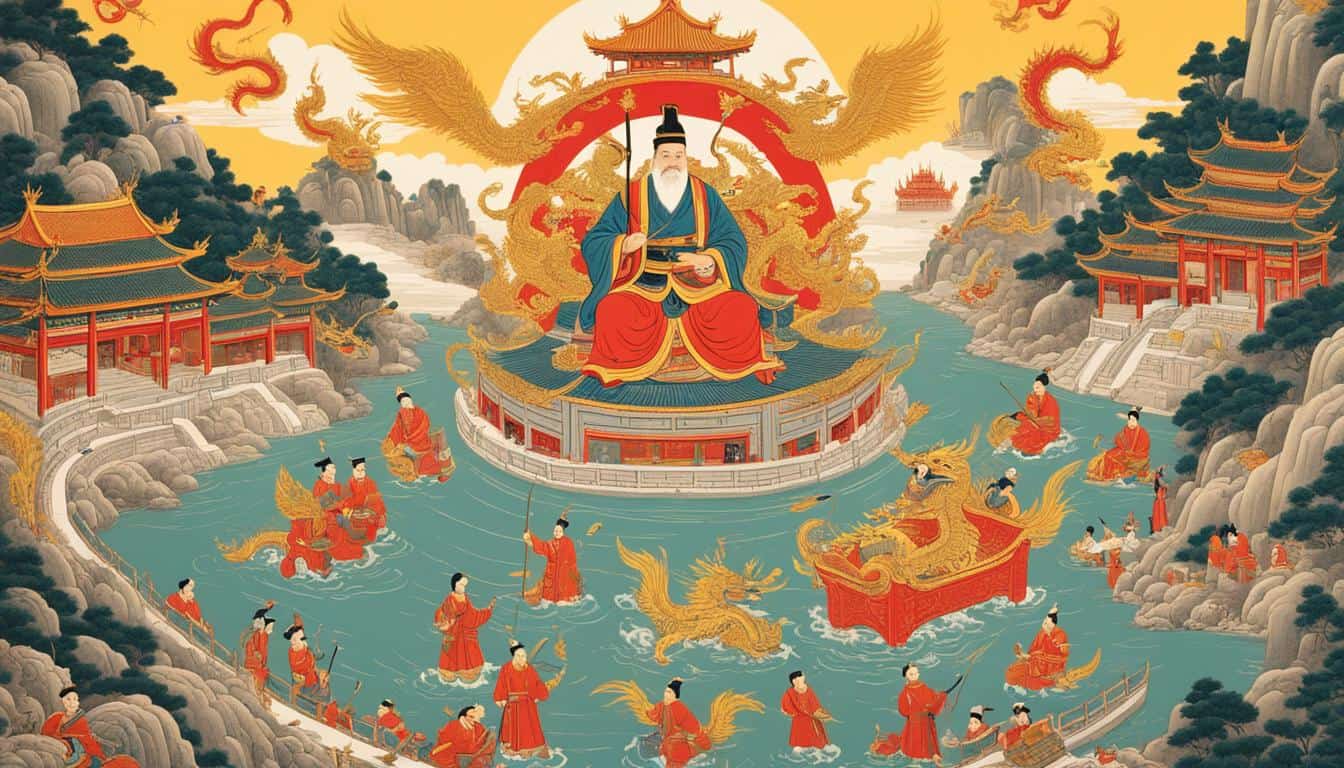
The Mandate of Heaven emerged as a grand celestial endorsement, a divine right granted to an emperor to rule the realm of ancient China. This concept underpinned the legitimacy of emperors, which was subject to the prerequisite of virtuous and benevolent governance. The cyclical rise and fall of dynasties were thought to be tied to the mandate, with natural disasters and social upheavals perceived as heavenly signs that the incumbent ruler had lost this sacred trust.
Confucianism’s Influence on Government Structure and the Scholar-Officials
Concurrently, Confucianism deeply permeated the imperial administration, advocating a systemic order grounded in ethics and moral righteousness. Its principles were instantiated in the government structure, elevating scholar-officials who became the cornerstone of the bureaucracy. These erudite individuals were selected through rigorous examinations, which sought to populate the civil service with the most virtuous and capable administrators. This established a revered class of scholar-officials whose intellect and moral compass steered the governmental machinery.
Evolving Roles of Emperors and Their Centralized Power
As dynasties transitioned, the role of the emperor evolved with the increasing consolidation of centralized power. This centralization was instrumental in reinforcing the emperor’s supreme authority over a vast and diverse territory. The efficacy of centralized power was particularly evident in the establishment of legal codes and the deployment of military force, which were strongly influenced by both the ever-expanding bureaucratic network and the doctrine of Confucianism, aiming to manifest a harmonious and orderly state.
| Dynastic Period | Centralization Characteristic | Role of Scholar-Officials |
|---|---|---|
| Qin Dynasty | Strong legalistic approach; unified laws and currency | Limited influence; overshadowed by autocratic rule |
| Han Dynasty | Expansion of centralized bureaucracy; Confucianism promoted | Institution of the civil service examination system |
| Tang Dynasty | Enhanced administrative divisions; advancements in tax systems | Increased authority in governance; cultural patronage |
The intricate dance between the divine right to rule, the wisdom of Confucian scholars, and the concentration of imperial power not only shaped the governance of ancient China but also laid the groundwork for the modern conceptualization of the state. Analyzing the progression of dynastic rule and its elements offers a profound understanding of China’s historical and cultural dimensions.
Imperial Innovations: Bureaucracy and Administrative Reforms
The intricate tapestry of imperial China’s governance was embroidered with a series of significant bureaucratic and administrative reforms, which were particularly pronounced during the illustrious Song Dynasty. Such imperial innovations were instrumental in streamlining governance efficiency, as they introduced meritocratic principles that fostered a professional bureaucratic class, setting the stage for robust administrative coordination. The acclaimed imperial examination system stood at the vanguard of these reforms, democratizing access to the bureaucratic elite, while departments and ministries served as the structural pillars of state administration, ensuring organized and responsive governance.
The Imperial Examination: Gateways to the Bureaucratic Elite
The imperial examination was a transformative innovation that provided the critical bridge between scholarly pursuit and bureaucratic appointment. This meritocratic system emphasized the importance of knowledge and abilities, ensuring that the most capable and learned individuals could ascend within the bastions of bureaucracy. It disrupted traditional nepotism, moving towards a governance structure that valued intellectual capacity and administrative proficiency over lineage.
Departments & Ministries: The Backbone of the Song Dynasty’s Government
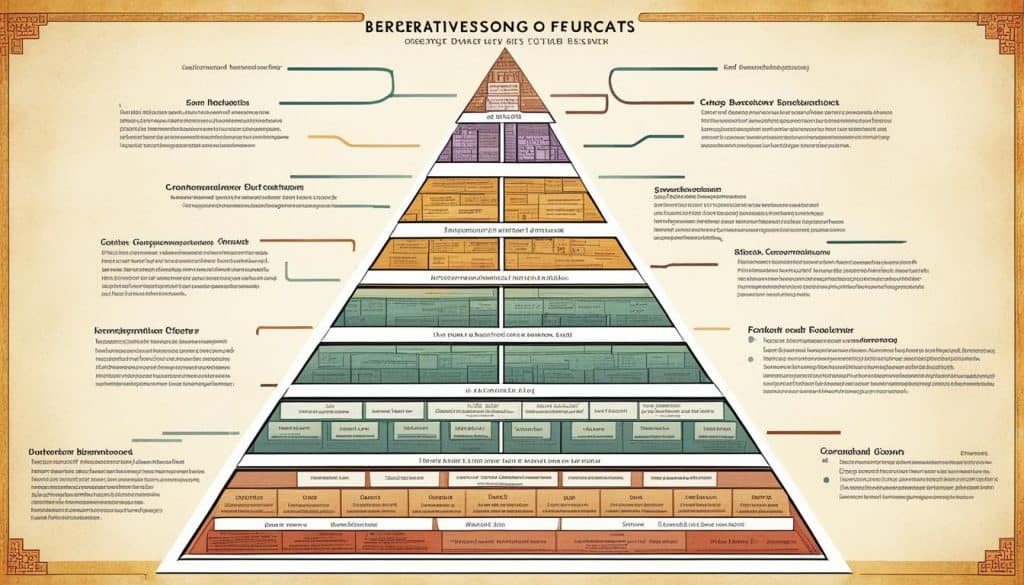
The Song Dynasty’s administrative machinery was complex and featured a multitude of departments and ministries functioning as the backbone of its governance apparatus. These entities were responsible for various aspects of state control, from financial oversight to military affairs. The structured hierarchy within these departments ensured a cohesive operational approach, critical for the ambitious reforms and expansive policies characteristic of the dynasty.
Meritocracy and Its Impact on Governance Efficiency
At the core of these administrative reforms lay the principle of meritocracy, which dramatically enhanced governance efficiency. It did so by incentivizing excellence and promoting a culture of achievement, where individuals were rewarded for their expertise and contribution rather than their social status. This shift not only honed the administrative acumen of the state apparatus but also cultivated a sense of fairness and opportunity within the imperial jurisdiction.
| Song Dynasty Department | Function | Impact on Governance |
|---|---|---|
| Ministry of Personnel | Overseeing civil service appointments | Enhanced bureaucratic meritocracy and quality of officials |
| Ministry of Revenue | Managing taxation and state finances | Improved financial stability and resource allocation |
| Ministry of Rites | Regulating court ceremonies and foreign affairs | Standardized protocols and reinforced diplomatic relations |
| Ministry of War | Supervising military and defense matters | Secured borders and maintained a standing military force |
| Ministry of Justice | Administering legal codes and judiciary activities | Ensured lawful conduct and order throughout the realm |
| Ministry of Works | Handling public works and government infrastructure | Fostered development and maintenance of essential facilities |
Government Systems Employed by Chinese Dynasties and How They Developed Over Time
Throughout the expansive history of China, the intricacies of government systems have been pivotal in shaping the nation’s legacy. The diverse tapestry of Chinese dynasties has seen an array of governance structures that reflected the philosophical and practical needs of their times. Starting with the quasi-feudal systems of the early dynasties, Chinese governance evolved through the ages, exhibiting sophisticated levels of administration and control. The developed dynamic systems were an amalgamation of legalist precepts, Confucian morals, and, at times, Daoist principles of governance.
Key to the evolution of government systems in these dynasties was the ability to centralize authority while embracing meritocratic ideals. This was exemplified by the evolution of the Imperial Examination, which cultivated a bureaucracy grounded in intellectual prowess rather than nobility. Additionally, advancements in administrative techniques allowed for the segmentation of governance into specialized departments, each focusing on particular societal needs, from agriculture to military strategies. The developed structural hierarchy within Chinese government not only stabilized the dynastic rule but also streamlined statecraft, impacting the socio-political landscape profoundly.
In conclusion, the various government systems employed by Chinese dynasties were remarkably adaptive, and their development was a continuous process of refinement and innovation. These systems were underpinned by cultural ideologies and were pivotal in the maintenance of order and prosperity throughout centuries of change. The enduring legacy of these adaptive systems can be traced through the enduring institutions and legal customs that have developed over time, showcasing the indelible mark of historical governance on modern-day China.