The United States federal government is steadfast in its commitment to the responsible stewardship of the nation’s land resources. A primary goal stands out in this mission: to ensure that the use and conservation of natural assets are sustainable, not only serving the current populace but safeguarding these treasures for future Americans. This entails preserving ecosystems, protecting biodiversity, fostering economic development, all the while enhancing the spaces where people can recreate and connect with nature.
Key Takeaways
- Ensuring sustainable resource use is a critical goal of the federal government’s land management strategy.
- Protection of biodiversity and maintenance of ecosystems are paramount to federal land stewardship efforts.
- Economic growth through responsible resource development is a key consideration in federal land management.
- Public recreation areas are created and maintained to enhance quality of life for current and future generations.
- Federal land management aims for a balance between resource utilization and environmental conservation.
The Scope of Federal Land Management in the United States
The vast expanses of natural landscapes in the United States are under the stewardship of the federal government, which holds significant tracts of land under its wing. The intricate tapestry woven by multiple-use philosophies and conservation efforts reveal the complex nature of federal land management. Sustaining and nurturing the rich resources of the nation, while providing ample opportunities for recreation and economic development, form the cornerstone of an extensive federal agenda.
Federal Land Ownership: Extent and Distribution
In the mosaic of American soil, the federal government’s share comprises a staggering 640 million acres, roughly 28% of the nation’s entire land area. This expansive ownership is not uniformly distributed but spans across various landscapes, ecosystems, and regions, each with unique characteristics and resources. The inherent value of these lands is safeguarded and managed by an intricate organization of federal agencies, each endowed with specific mandates to handle the diverse challenges and prospects presented by these natural assets.
Major Agencies in Charge of Federal Land Administration
Four principal custodians — the Bureau of Land Management, Fish and Wildlife Service, National Park Service, and Forest Service — oversee the lion’s share of federal lands, accounting for approximately 95% of government-held terrain. Each agency brings forth its own focus, from the BLM’s dedication to multiple-use and sustained yield to the FWS’s commitment to wildlife and habitat conservation. Likewise, the NPS and FS each manage their realms with distinct objectives that align with their foundational principles, thereby ensuring that each acre of federal land is managed with purpose and precision.
Annual Budget Allocated for Land Management
Although the full extent of federal spending on land management is shrouded in the complex veils of budgetary paperwork, appropriations for the four core land management agencies amounted to a formidable $15.47 billion in the fiscal year 2016. This financial backbone supports a plethora of activities, from maintaining the ecological integrity of wildlife habitats to facilitating public engagement and recreation, thus ensuring that federal lands remain a treasure for all citizens to explore and enjoy.
What is a Major Goal of the Federal Government When Managing Land Resources?
The stewardship of land is a cornerstone of federal responsibilities, with a significant emphasis on mediating a harmonious relationship between progression and preservation. The integration of conservation policies with the pursuit of economic ventures marks a pivotal federal assignment, where ensuring the vitality of natural resources parallels the generation of societal wealth.
Strategic land management encompasses a matrix of undertaking, navigating the complex interplay of environmental, economic, and social parameters. This matrix is a testament to the federal government’s commitment to fostering sustainable development—a keystone for contemporary and future societal imperatives.
- Encouraging renewable energy advancements
- Promoting sustainable agricultural practices
- Enhancing recreational spaces for public use
- Implementing land conservation strategies
- Maintaining biodiversity and protecting ecosystems
Integral to these objectives is the dynamic discourse with stakeholders across the spectrum, ensuring that decisions are inclusive and beneficial on a communal scale. These dialogues are fueled by the belief that today’s resources are a legacy for tomorrow’s inhabitants.
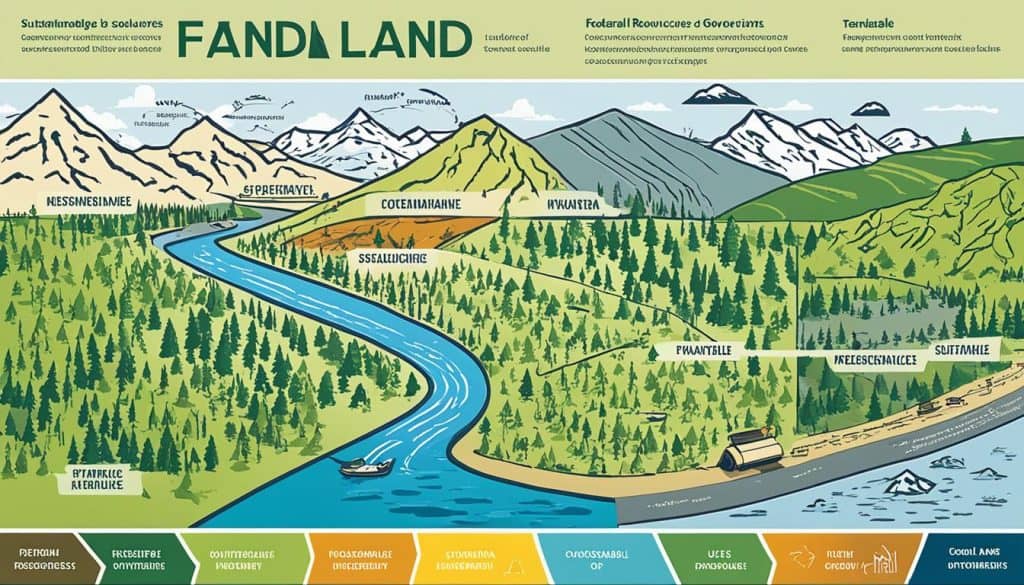
The aim of the federal government endeavors to solidify the foundational balance needed to navigate and negotiate the often-competing demands of development and environment. Investing in the resilience of ecosystems and promoting diversity in land use emerges not as a lofty ideal but as a tangible strategy for sustenance and growth. The essence of sustainability lies within the meticulous crafting of practices that are both forward-thinking and grounded in ecological prudence.
Ultimately, the role of the federal government branches beyond mere management; it serves as a guardian of the nation’s patrimony, a patrimony intricately woven with the tapestry of ecological well-being and human prosperity.
Multipurpose Land Stewardship: Balancing Use and Conservation
The Bureau of Land Management’s approach encapsulates the intricate practice of juggling numerous land uses while ensuring sustainable availability for future needs. It is an elaborate dance of administration that is essential in today’s context of varied interests and diverse ecological necessities.
The Dual Mandate of the BLM and FLPMA
Established by the Federal Land Policy and Management Act, the BLM has been entrusted with a complex task. Its directive encompasses multiple-use and sustained yield principles, which mandate a diverse canvas of activities ranging from resource extraction to recreation, all under the umbrella of long-term preservation.
Managing Conflicts Among Multiple Land Uses
Navigating through the maze of conflicting land use demands is not devoid of hurdles. The varied tapestry of interests that accompany energy sectors, agricultural needs, and environmental conservation goals require a mosaic of strategies to align these divergent paths towards a consensus that benefits all stakeholders involved.
Conservation Efforts for Future Generations
Central to the ethos of land stewardship is the conservation of natural treasures. Enshrining areas for protection and crafting policies to defend against overuse, the federal government lays the groundwork for securing a legacy of biodiversity and unspoiled landscapes for generations to come.

| Aspect of Land Management | Approach by BLM | Stakeholder Involvement |
|---|---|---|
| Resource Extraction | Regulated development ensuring future availability | Industry consultations and partnerships |
| Agricultural Use | Grazing permits with sustainability focus | Collaboration with farmers and ranchers |
| Recreational Access | Facilitation of access with environmental safeguards | Engagement with recreation and tourism stakeholders |
| Conservation Initiatives | Protected areas and species-specific programs | Partnerships with conservation organizations and local communities |
Strategic Challenges and Initiatives in Federal Land Management
As stewards of the nation’s extensive natural resources, federal land management authorities confront an evolving array of strategic challenges, chief among them being the profound effects of climate change. The warming climate poses significant risk to the biodiversity, water resources, and overall landscape integrity of federal lands. To navigate these challenges, agencies are increasingly prioritizing adaptive management—a dynamic and science-based approach that allows for policy and practice to evolve in response to new information and changing conditions. This approach helps to ensure that resource management strategies remain effective under climate change scenarios.
Inter-agency collaboration and coordination remain pivotal in the quest for efficacious federal land management. A coordinated effort is required to effectively manage the maintenance backlog of aging infrastructure that is crucial not only for conservation efforts but also for facilitating public access and enjoyment. Solutions are sought through systematic planning and budgeting, as well as the exploration of innovative funding mechanisms to tackle the accumulation of necessary repairs and improvements.
Ensuring the engagement of local communities and stakeholders stands as a fundamental initiative within federal land management strategies. The integration of local perspectives and traditional ecological knowledge complements scientific data, providing a rich, multidimensional understanding of the ecosystems under management. The pursuit of landscape-scale planning underscores the vastness and connectivity of ecosystems, transcending the limitations of traditional site-specific management efforts to produce more comprehensive and enduring outcomes. The collective aim of these initiatives is to fortify the resilience and sustainability of land management practices, with a clear-eyed view of the legacy we bequeath to future generations.