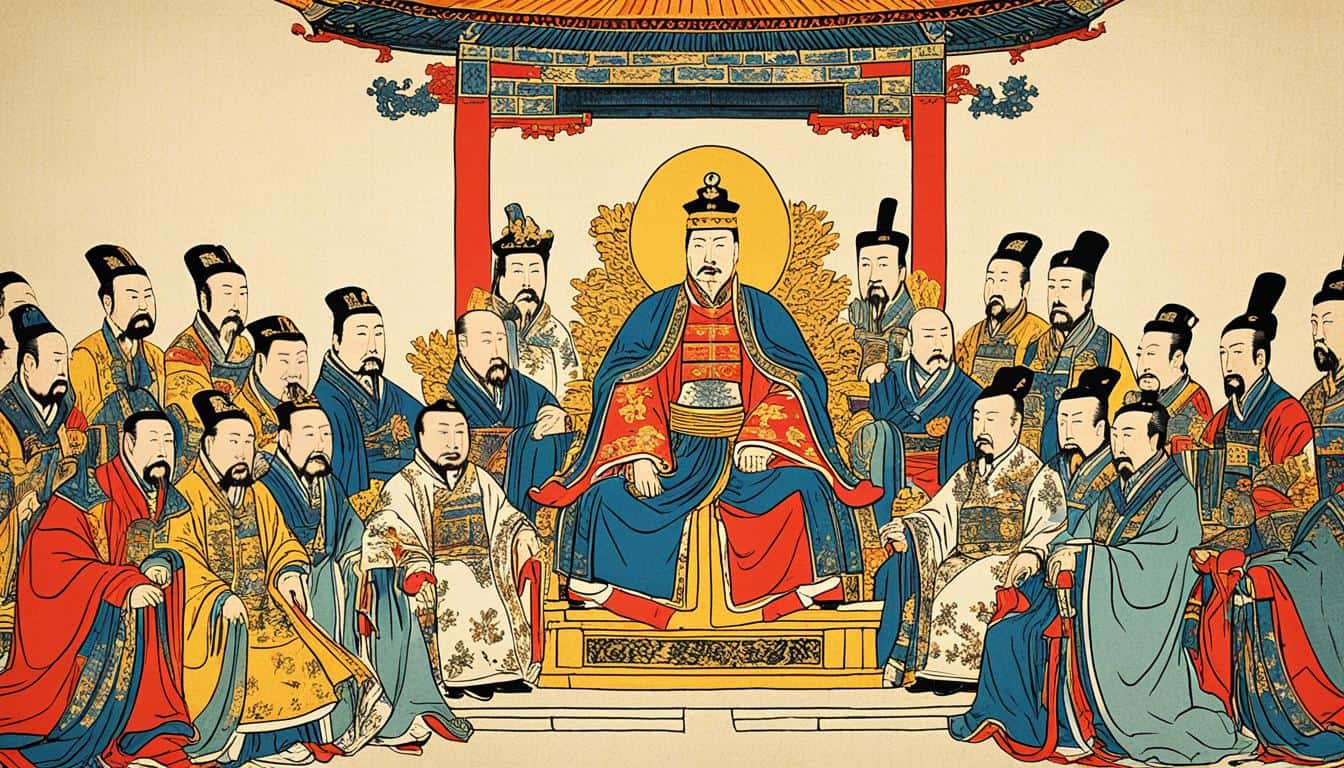
Throughout its storied past, ancient China was steered by a succession of ruling families, known as dynasties, under a framework of governance that centered around an emperor at the peak of power. The sophisticated system of ancient Chinese government was deeply entwined with the philosophical and ethical currents of the time, influencing every aspect from administration to cultural expression. This dynamic governance, intrinsic to the Chinese dynastic rule, shaped the country not only politically but also left an indelible mark on social organization and cultural development.
The narrative of ancient China governance illustrates a complex tapestry of transitions from one dynasty to another, each imprinting its unique methodologies and principles. As we embark on this historical sojourn, we will uncover facets of ancient Chinese government that have sustained and evolved through millennia, leaving a legacy that endures to this day.
Key Takeaways
- Understanding of the emperor-centric Chinese dynastic rule and its shaping of ancient China.
- Insight into the societal and cultural ramifications of ancient Chinese governance.
- Familiarization with the evolution of governance throughout China’s various dynasties.
- Appreciation for the lasting impact of ancient governance systems on modern China.
- Recognition of the historical significance of ancient Chinese government structures.
Autocratic Monarchy: The Bedrock of Chinese Governance
The annals of history reveal that an autocratic monarchy in ancient China played a pivotal role in shaping the country’s legacy, characterized by a decisive centralization of power. This profound system of governance hinged on the absolute authority of the emperor, often leading to radical policies including the burning of books in ancient China, which sought to consolidate emperorship and quash dissenting ideas.
Establishment of the First Unified Monarchy
During the turbulence of the Warring States period, the quest for unity and stability led to the emergence of the first centralized government. The ambition was not just to rule but to establish a harmonious society under the guidance of a single, omnipotent ruler.
Consolidation of Power and the Burning of Books
The infamous tutelage of the Qin Dynasty spotlighted the critical intersection of knowledge and authority. In a bid to maintain an unyielding grip on the state’s narrative, the dynasty undertook the extreme measure of the burning of books, intending to erase conflicting philosophies and ideologies.
The Evolution of Centralized Authority and its Impact
The tapestry of China’s vast history is embroidered with tales of dynastic prowess and the constant transformation of an autocratic system. The autocratic monarchy in ancient China not only dictated the governance of yesteryears but also molded the societal structure, leaving an indelible impact on the development of Chinese civilization.
What Type of Government Did Ancient China Have?
The intricate tapestry of the ancient Chinese government structure reveals a multifaceted panorama of power dynamics, characterized by a spectrum of forms of government in ancient China. The historical narrative unfolds a complex blend of autocracy, bureaucracy, and occasionally elements of meritocratic practices woven into the imperial fabric.
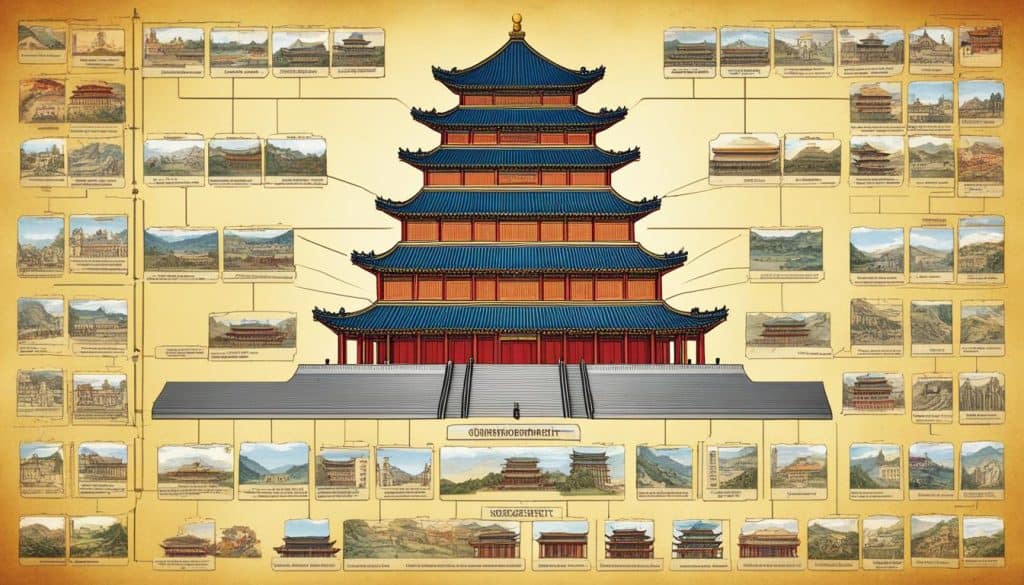
At the apex of authority resided an absolute monarch – the Emperor. This autocratic figure wielded central power, setting the course for national policy and personal dictates, encapsulating the core of the ancient Chinese government structure. Underneath this absolute rule, multiple layers of administrative offices ran the vast expanse of the empire, reflective of the diverse forms of government in ancient China.
- Ancestral Monarchy: In the earliest dynasties, government was familial. The right to rule was passed from one generation to the next within the ruling clan.
- Feudal States: As territories expanded, a feudal system took hold, with regional lords exercising control over their respective lands, albeit under the emperor’s overarch.
- Bureaucracy: A more mature phase saw the introduction of a structured civil service, bringing forth the skill-based administrative class.
- Meritocracy: While not a government form per se, the Bureaucracy eventually evolved into a meritocratic system where civil service examinations determined eligibility for government positions.
The breadth and longevity of the ancient Chinese government structure were due to its ability to adapt and incorporate various bureaucratic elements, which allowed it to handle a myriad of administrative tasks across a considerable geographical scope and throughout different forms of government in ancient China. Yet, despite these complexities, the Emperor remained the pivotal figure, and his decrees were absolute, demonstrating a continuity of central authority across dynasties.
Meritocracy and the Civil Service: Foundations of Bureaucracy
The backbone of governance in ancient China was an intricate and robust Chinese bureaucracy sustained by a system that was far ahead of its time: the Chinese civil service examination. This merit-based structure was instrumental in shaping the administrative framework of the nation and stands as a testament to the ingenuity of ancient Chinese civilization.
The Intellectual Rigor of the Examination System
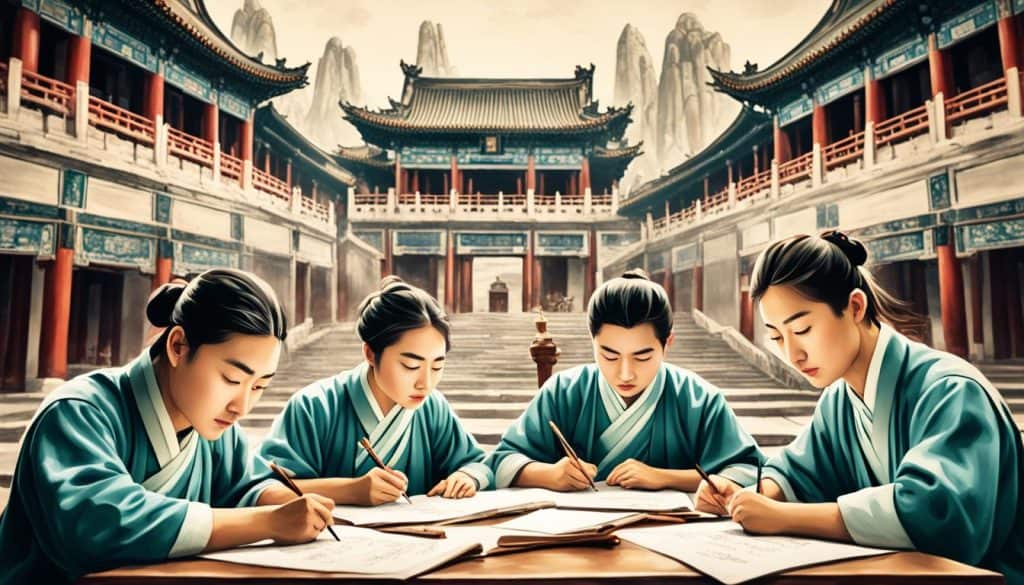
The intellectual challenge posed by the civil service examination cannot be overstated. This rigorous process was designed to filter and select the most capable individuals for public service. By focusing on Confucian classics, the examinations required a profound level of knowledge and understanding, ensuring that the officials at the helm of the Chinese bureaucracy were highly qualified and competent.
From Local Scholars to Imperial Elites: The Rise of a Meritocracy
In the evolution of meritocracy in ancient China, the examination system acted as a social elevator, allowing scholars from modest backgrounds to ascend into the ranks of imperial elites. It wasn’t birthright or connections that defined one’s role in the bureaucracy, but rather intellectual mettle and meritorious deeds. This egalitarian aspect of the system speaks volumes of the values held by the ancient Chinese society, where wisdom and ability were held in the highest esteem.
Western Admiration for Chinese Meritocracy and Governance
The impressiveness of the Chinese meritocracy and governance systems did not go unnoticed by the Western scholars such as Voltaire and Ralph Waldo Emerson. They expressed deep admiration for the way ancient China filled the echelons of power, not through lineage or wealth, but through a demonstrated capacity and aptitude for governance – an admiration that has continued to be a topic within intellectual circles discussing effective governance systems to this day.
The Balancing Act: Local Interests and Imperial Mandates
The intricate tapestry of ancient China’s governance was characterized by the deft handling of both local interests and imperial mandates. Delving into the historical practices, it becomes evident that the Chinese government was adept at navigating the complexities that arose from the dual needs of affirming central authority while permitting enough autonomy to keep local governance in ancient China responsive to the people. Policies were nuanced and often bespoke, tailored to bridge the intricacies of a vast empire with a multitude of cultures, languages, and traditions under its rule.
Implementing imperial mandates often required a delicate negotiation of power, where the central government sought to enforce conformity and control over distant provinces. At the same time, it recognized the necessity to accommodate local governance practices and traditions that had been entrenched for centuries. This synthesis of control and concession was vital to maintain the stability of an empire that extended over a significant part of Asia. The central authorities often sent imperial inspectors to oversee local administration, ensuring that imperial interests were safeguarded while allowing local leaders to manage day-to-day affairs. This signified an early form of federalism, balancing unity with respect for local governance in ancient China.
The impact of this balancing act on Chinese society and its local communities was profound. While the empire thrived under a uniform set of laws and cultural practices promulgated by central edicts, localities retained a sense of identity and autonomy, which was crucial for the local interests and the overall robustness of the empire. This exploration into the dynamic between central mandates and local interests provides profound insights into the complexities of governance that ancient China has successfully navigated—a lesson in political harmony that speaks volumes even in contemporary governance discussions.