Kenya operates under a republic with a democratic system of governance. Central to the political system in Kenya is its tripartite division, comprising the executive, legislative, and judicial branches, as delineated in the country’s pivotal 2010 constitution. This constitution enshrines the separation of powers and ensures civil liberties for all Kenyans, reflecting the thoughtful intricacies of the Kenya government structure.
Key Takeaways
- Kenya is a republic, adhering to the tenets of a democratic system of governance with a clear separation of powers.
- The 2010 constitution of Kenya is a cornerstone, defining the political system in Kenya and asserting the rights and freedoms of its citizens.
- Kenya’s executive branch is headed by a president, who is both the head of state and government, and is elected directly by the populace.
- The legislative power is vested in a bicameral parliament consisting of the Senate and the National Assembly.
- An independent judiciary in Kenya ensures the rule of law and justice, acting as a check on the other branches of government.
An Overview of Kenya’s Government Structure and Its Democratic Foundations
Kenya’s political system is anchored in the values of republicanism, which are eloquently enshrined in the Kenya constitution. As a beacon of democracy in East Africa, Kenya has continuously committed itself to the principles of representative governance, where the sovereignty is vested in its people.
Kenya’s Affiliation with Republic Principles and the 2010 Constitution
The 2010 constitution marks a pivotal transformation in Kenya’s governance, enshrining the rights and responsibilities of its citizens and providing a robust framework for the Kenya political system. It signifies a transition towards more inclusive and transparent governance, aiming to foster unity and national development.
The Separation of Powers: Executive, Legislative, and Judicial Branches
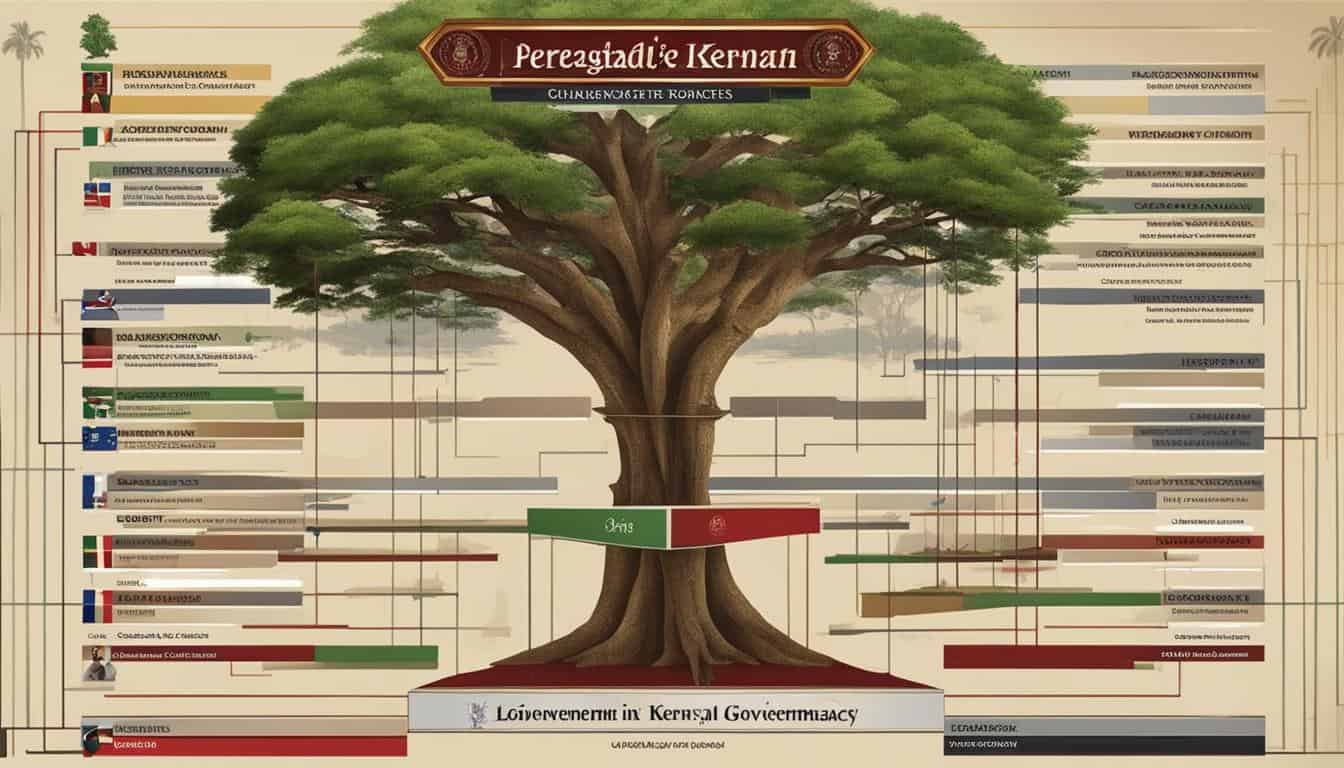
The executive, legislative, and judicial branches form the pillars of Kenya’s government, operating within a system of checks and balances designed to prevent the concentration of power. The president stands at the helm of the executive branch, directly elected to lead and administer government affairs. Below is a table summarizing the structure:
| Branch | Composition | Primary Function |
|---|---|---|
| Executive | President, Deputy President, Cabinet | Implement and enforce laws |
| Legislative | Senate and National Assembly | Law-making |
| Judicial | Supreme Court, Appellate and Lower Courts | Adjudication and legal interpretation |
Electoral Process: Upholding Democratic Elections Since Independence
Since its independence, Kenya has exemplified the commitment to democratic elections in Kenya, regularly conducting electoral processes to choose its local and national leaders. This enduring practice is a testimony to the nation’s allegiance to the democratic ideals and the will of its people, demonstrating progress and political maturity.
The Role of the Judiciary in Kenya’s Government System
The Kenya judiciary is a cornerstone of the nation’s democratic framework, entrusted with a plethora of critical tasks that underscore the role of courts in Kenya. With the mandate to interpret laws and deliver justice, the judiciary safeguards the constitutional rights and liberties of Kenyans, fostering a just society underpinned by the rule of law.
In its capacity as an arbiter, the Kenya judiciary operates through a hierarchy of courts, each playing a distinct yet interrelated role within the broader judicial mechanism. This includes the Supreme Court at the apex, followed by the Court of Appeal, the High Court, and the Magistrates’ Courts. The seamless operation of these judicial entities is orchestrated by the Chief Justice, who leads the judiciary’s administrative functions and serves as a symbol of its autonomy and integrity.
Demonstrating its integral role of courts in Kenya, the judiciary serves to balance the scales among the government’s branches, vigilantly ensuring that both the executive and legislative bodies act within their constitutional bounds. This system of checks and balances is fundamental to preventing the overreach of power and preserving the democratic ethos that defines Kenya’s governance.
- Supreme Court: It serves as the highest judicial authority, principally dealing with presidential election disputes and matters concerning constitutional interpretation.
- Court of Appeal: It handles appeals from the High Court and tribunals, ensuring that justice is upheld at multiple levels.
- High Court: It presides over significant criminal and civil cases, as well as judicial review and constitutional matters.
- Magistrates’ Courts: These are the first point of contact for most legal disputes and handle a wide range of criminal and civil matters.
The Kenya judiciary maintains a critical liaison with the public, not only through the adjudication of cases but as a guardian of the Constitution. Through its judicious interpretations, it has the power to shape the nation’s legal landscape and influence societal norms. In essence, the judiciary acts as the bulwark against tyranny and lawlessness, invariably working towards a more equitable and just Kenya.
Presidential Powers and Executive Authority in Kenya
The realm of executive power in Kenya is a testament to the significant role that the president plays in shaping the nation’s future. As the head of state and government, the president of Kenya wields substantial authority, a direct reflection of the trust placed in this office by the citizens through the electoral process. Kenya president powers encompass critical responsibilities such as appointing and dismissing cabinet secretaries, a testament to the office’s influence over the nation’s governance and administrative machinery. The vigorous execution and enforcement of laws are also central to the president’s obligations, ensuring that legal and policy frameworks are effectively translated into tangible actions for the benefit of the populace.
In the sphere of international diplomacy, the president’s capacity to represent Kenya globally is paramount, positioning the nation strategically on the world stage. This facet of executive authority in Kenya extends to times of crisis as well; the president holds the prerogative to declare a state of emergency, thereby adapting the nation’s governance mechanisms to the exigencies of extraordinary circumstances. Commanding the defense forces further underscores the gravity of the president’s role in maintaining national security and sovereignty. These facets of presidential powers are fundamental in not only guiding domestic policies but in safeguarding the nation’s interests against external challenges.
Yet, while the president’s influence is undeniable, it operates within a framework of accountability and balance. Elected for a five-year term by the general populace, the president’s actions and decisions are circumscribed by the country’s robust constitution, designed to ensure that Kenya’s democratic ethos is upheld. Additionally, the checks and balances afforded by the legislative and judicial branches act as crucial counterweights to executive authority in Kenya. By maintaining this equilibrium, Kenya ensures that the president’s executive powers serve the nation’s interests while adhering to the rule of law and nurturing the democratic principles that are the bedrock of its political system.