The prospect of a U.S. government collapse is an unprecedented and uncertain scenario that would lead to considerable societal and economic impact of government collapse. Such a collapse would trigger a chain reaction across various domains, including but not limited to social order, financial systems, and international relations. Exploring the consequences of government collapse isn’t just an exercise in hypotheticals; it serves as a cautionary contemplation of the intricate interdependencies that sustain global stability.
Key Takeaways
- Understanding the consequences of government collapse helps in appreciating the complex ties within international systems.
- The societal and economic impact of government collapse would be both immediate and enduring, with effects felt worldwide.
- Financial markets, trade deficits, and currency reserves would directly experience the instability resulting from a U.S. government collapse.
- Domestic disruption would lead to global consequences, highlighting the role of the U.S. in the current geopolitical landscape.
- The unprecedented nature of such an event means predictions are complex and multifaceted, pointing to a variety of potential outcomes.
- Resilience and response strategies could significantly influence the recovery from a governmental collapse.
Immediate Global Economic Repercussions
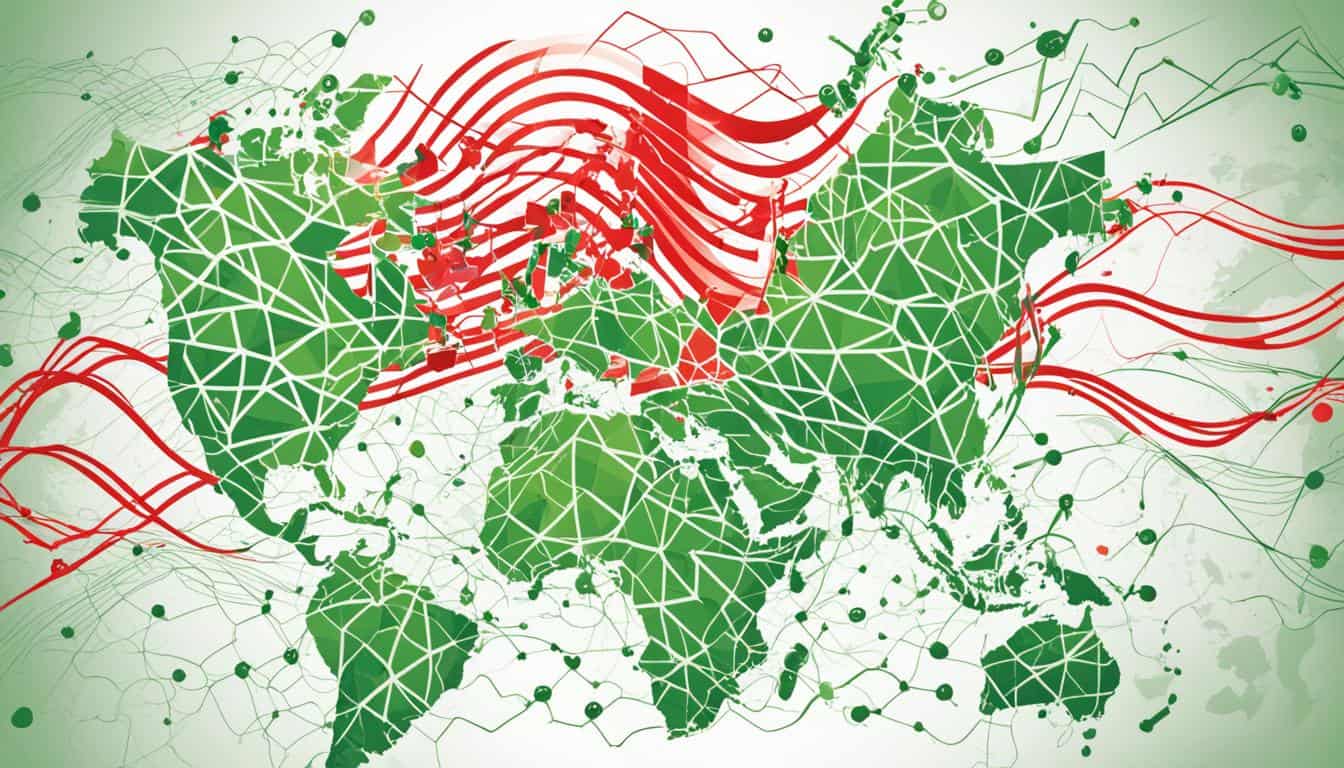
The unthinkable demise of the U.S government’s functionality would create a chain reaction with considerable global economic impact. At the heart of this disturbance would be a weakened international market stability, a retreat of foreign investments, and the emergence of new trade deficits. Moreover, a reassessment of global currency reserves would be imminent, challenging the dollar’s dominance. The integration of these components forms a precarious situation for the world economy.
The Seismic Impact on International Markets
As the backbone of the international economy, the U.S. exerts substantial influence on the markets. A collapse would mean a loss of confidence in U.S. financial instruments, leading to widespread uncertainty. Equity markets might plummet and the ripple effect could see even the most robust economies scramble to mitigate the effects.
Shockwaves in Foreign Investments and Trade Deficits
Foreign investors, who are significantly leveraged in U.S. assets, would find themselves navigating a labyrinth of fiscal depreciation. Investment portfolios would take a hit as the value of U.S. bonds and securities tumble, escalating trade deficits, particularly for those countries reliant on U.S. consumer markets.
Consequences for Global Currency Reserves and the Dollar’s Dominance
In the global currency arena, the dollar has long held sway as the currency of choice for reserves. Its faltering would prompt a strategic move towards a more varied reserve allocation, possibly favoring currencies like the euro or yen, thus ending the unipolar currency order.
| Global Market Aspect | Pre-Collapse State | Post-Collapse Forecast |
|---|---|---|
| International Market Stability | Reliance on U.S. dollar and securities | Increased volatility and risk aversion |
| Foreign Investments | Attraction to U.S. debt instruments | Capital withdrawal and search for safer assets |
| Trade Deficits | Contained by U.S. consumption patterns | Potential widening due to trade disruption |
| Global Currency Reserves | Dollar-dominant reserves | Possible diversification into other currencies |
Long-term Socioeconomic Fallouts and Recovery Scenarios

The socioeconomic impacts of government collapse can be profound, with the repercussions lasting for years, if not decades. Divulging into the core of these impacts exposes a disintegration of the societal framework, presenting a plethora of long-term consequences that can range from economic turmoil to severe societal unrest. It is essential to consider both the challenges and potential avenues for recovery.
Acknowledging the severity of these impacts, it’s crucial to understand the recovery scenarios that may play out. At the forefront of these recovery efforts, stabilization policies and strategies for rebuilding the trust of the populace will be imperative. The emphasis on reconstructing the social safety nets and reigniting economic engines requires a concerted effort across multiple sectors—from government entities to grassroots organizations.
- Economic Resilience and Job Creation Programs
- Infrastructure Rehabilitation and Investment
- Mobilization of Community Resources
- Engagement in Global Alliances for Economic Support
Exploring these long-term consequences, it is not just about analyzing the economic downturns or societal dislocations; it’s also about reassessing the very principles that underpin our nation’s foundation. The task of averting further societal unrest, which often stems from the absence of governance and declining living standards, becomes a pivotal element of any post-collapse discourse.
| Impact | Consequence | Potential Recovery Step |
|---|---|---|
| Job Market Collapse | Surge in Unemployment | Implementation of Federal Employment Initiatives |
| Weakening of Social Services | Increase in Poverty Rates | Revitalization of Social Programs and Safety Nets |
| Erosion of Public Trust | Rise in Civil Discontent | Community Engagement and Transparent Governance |
| Economic Downturn | Decline in GDP | Strategic Economic Stimulus Packages |
What Would Happen if the U.S. Government Collapsed
The unthinkable scenario of a U.S. government collapse is not only a concern for the nation but also for the entire world, given America’s position in global power dynamics. The potential outcomes of government collapse are multifaceted and grim, with far-reaching implications that could reshape international relations. If the country’s federal structure were to fail, it might not only precipitate a shift in geopolitical power but could also plunge the world into a new era punctuated by escalating geopolitical conflicts and the dissolution of long-standing alliances.
In the immediate aftermath of such a collapse, we could foresee regions within the U.S. succumbing to regional fragmentation, where states or territories choose divergent paths in the quest for stability and governance. Concurrently, global power dynamics would likely experience a seismic shift as countries like Russia, China, and India vie for increased influence, altering the balance of international relations. The dissolution of cooperative bodies like NATO would signal a pivotal descent into an era where historic partnerships are uncoupled, leaving vacuums that could expedite the rise of new coalitions or foster isolationist tendencies.
In this delicate geopolitical tapestry, the escalation of conflicts could become more rampant without the diplomatic and military influence of a united United States to mediate. Further, the ramifications of such a collapse would be felt across various spectrums of global affairs—from commerce and trade to the ideological spread, such as a possible incline towards communism in susceptible regions like Southeast Asia. The intricate interdependencies of nations mean that any significant disruption, notably one as profound as the collapse of a government, reverberates across borders, demanding astute attention and action from world leaders and international organizations.