Bolstering Italy’s global presence, Benito Mussolini’s regime was marked by aggressive foreign policy actions aimed at strengthening Italy. These strategic maneuvers, crafted to reassert Italian power, focused on territorial expansion, robust military campaigns, alliances, and military strategy enhancement. The imprint of Mussolini’s foreign policy has left a defining legacy on Italy’s historical narrative and on the global stage.
Key Takeaways
- Mussolini sought to amplify Italy’s international influence through calculated foreign policy.
- The regime’s primary focus was territorial expansion, encapsulating military aggressions and annexations.
- Alliances and shifts in diplomatic relationships were central to reinforcing Italy’s position in the face of global sanctions.
- The development and strengthening of the Italian military were critical to supporting Mussolini’s foreign policy objectives.
- These historical actions by Mussolini continue to be a point of study for their impact on Italy and global affairs.
Expanding The Italian Empire: Mussolini’s Visions of Colonial Dominion
Under the fervent leadership of Benito Mussolini, Italy embarked on an aggressive pursuit to re-establish a formidable Italian empire and assert its dominance as a colonial power. Driven by visions of a modern Roman Empire, Mussolini’s Italy turned its gaze towards Africa and the Mediterranean to instigate a series of military campaigns that would leave an indelible mark on the history of colonial dominion.
Military Campaigns in Africa and the Mediterranean
The Italian military expeditions across Africa and the Mediterranean signified Mussolini’s imperialist aspirations. Supported by a nation wrought with nationalist sentiment, these military campaigns were critical in asserting Italy’s might and reviving the spirit of past glories. It was within the arid landscapes of Africa and the strategic coastal zones of the Mediterranean that Italy sought to establish new realms of influence and colonial dominion.
Annexation of Ethiopia and the Advent of Italian Colonialism
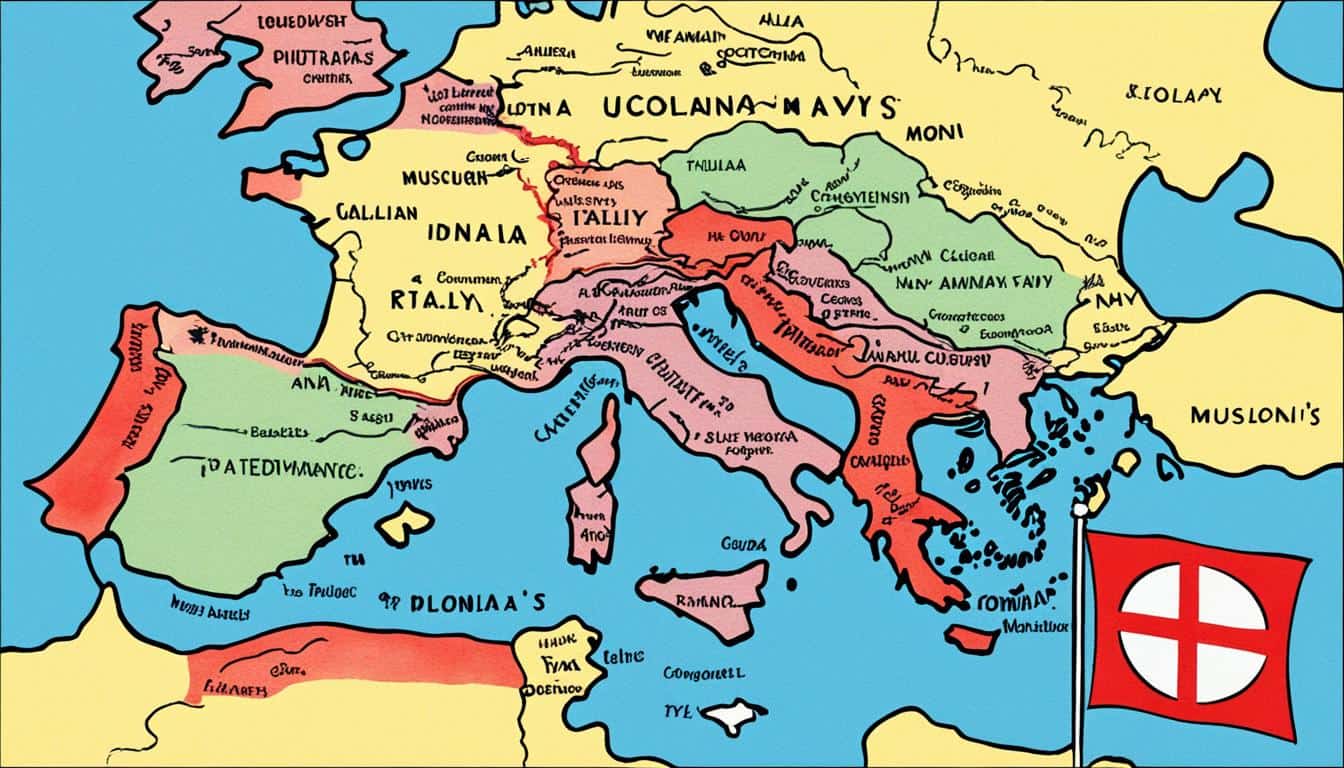
The annexation of Ethiopia in 1936 marked a watershed moment in the expansion of the Italian empire. This military conquest not only symbolized the inception of Italian colonialism in Africa but also represented a pivotal turning point where international opposition to Italy’s colonial pursuits began to intensify. The Ethiopian campaign served as a testament to Italy’s resolve to extend its empire by any means necessary, reigniting imperial sentiments that echoed throughout the Italian peninsula.
The Invasion and Subsequent Control of Albania
Italy’s colonial appetite did not end with Africa. In 1939, the Italian empire made its presence felt on the European stage with the invasion and occupation of Albania. This maneuver further extended Italy’s reach, bringing the Balkan nation under Italian influence and effectively entrenching the country’s authority in the Mediterranean region. Mussolini’s ambition was clear: to resurrect an empire that could rival the colonial powers of the time, and Albania became one step towards this grandiose objective.
Through these efforts, the Italian empire under Mussolini reinforced its position as a formidable colonial dominion during a tumultuous era of rival imperialist nations. From the sands of Ethiopia to the shores of Albania, Mussolini’s campaigns left an indelible impact on the historical and geopolitical landscape of the 20th century.
The Shift in Alliances: Mussolini’s Diplomatic Moves and the “Pact of Steel”
The conclusion of the Italo-Ethiopian War left Italy in a complex diplomatic quagmire, with international relations soured and the League of Nations imposing damaging sanctions. Mussolini’s response was not to retreat but to recalibrate his alliances. Recognizing the evolving geopolitical landscape, Italian diplomacy took on a pragmatic, although controversial, shift in pursuit of national interests.
Navigating the Aftermath of the Italo-Ethiopian War
Once the drums of war quieted, Italy found itself in isolation, as the sanctions imposed by the League of Nations took effect. Diplomacy played a vital role in this scenario, as Mussolini sought to navigate the aftermath. The sanctions—though initially not comprehensive—impacted the Italian economy and hinted at the potential for further diplomatic isolation. Beyond economic ramifications, the Italo-Ethiopian War had tarnished Italy’s international reputation, necessitating a shift in foreign policy.
Entering Hitler’s Orbit to Counteract the League of Nations’ Sanctions
The estrangement from Western powers drove Mussolini into the arms of Germany and its increasingly influential leader, Hitler. The result was the formation of alliances determined to redefine power dynamics in Europe. In 1939, Italy and Germany inked the “Pact of Steel,” a military and political alliance that stood as a direct affront to the authority of the League of Nations. This dramatic shift was not solely a reactive stance against the sanctions but also a proactive strategy to solidify Italy’s power on the global stage.
As Italy leaned into its partnership with Germany, the fabric of international diplomacy began to change. The Pact of Steel, emblematic of Mussolini’s willingness to engage in high-stakes diplomacy, embodied an era where the discourse of alliances radically shifted the landscape and set the stage for further conflict.
Molding the Italian Military Might and Strategy
The ascension of Mussolini’s regime heralded a period of rigorous restructuring and empowerment for the Italian military. With an ambition to project Italy as a formidable power on the global stage, Mussolini channelled vast resources into reshaping the military strategy. In line with autarkic principles, the Italian military underwent a transformation that encompassed not only quantitative but also qualitative enhancements.
Under Mussolini’s directive, the Italian military was reinvigorated with advanced weaponry, tactical training, and a revitalization of naval and air force capacities. The strategy was to build a military that could swiftly and effectively project power, especially across the Mediterranean and North Africa, regions that were critical to Mussolini’s vision of an expanded Italian empire. This strategy involved not just brute force, but also tactical maneuvering that elevated the Italian military methodologies on the world scene.
Indeed, Mussolini’s focus on military strategy reflected in the campaigns undertaken throughout his leadership. The synergy of a well-equipped military with a strategic mindset was intended to fortify Italy’s international presence and support Mussolini’s aggressive foreign policy pursuits. This comprehensive military strategy under Mussolini was critical to establishing Italy’s prominence and fearlessness in intergovernmental affairs during his tenure.