As the fledgling nation embarked on the grand experiment of democracy, the first Congress grappled with a defining issue that deeply divided its members: the scope and powers of the federal government. This seminal debate not only framed the infancy of the new government but also sowed the seeds for the eventual emergence of political factions, prefiguring the party system that characterizes American politics today.
The schism within the first Congress over the extent of national authority was not merely a disagreement over policies but a fundamental clash of visions for the country. On one side were those advocating for a robust national government capable of governing a unified nation, while on the other, proponents of minimal federal intervention championed the primacy of state rights. This divide would influence the trajectory of the burgeoning republic and shape the very core of its governance structure.
Key Takeaways:
- The first Congress faced a groundbreaking debate that divided its members on the role of the federal government within the new nation.
- This division laid the groundwork for future ideological battles and the development of American political parties.
- The clear differences in visions for the nation’s future reflected a dichotomy between strong central governance and states’ sovereignty.
- The resolutions from these early debates set precedents for the balance of power between the national and state governments.
- The outcome of these discussions had long-lasting implications for the political, social, and economic landscape of the United States.
The Formation of a Federal Government: The Adoption of the Constitution
The pivotal moment in American history when the federal government took shape was marked by vigorous debates, compromises, and tireless advocacy for the adoption of the U.S. Constitution. Casting aside the loose alliance of states under the Articles of Confederation, the founding fathers carved a path towards a robust federal government capable of enduring the tests of time and governance.
The Path from the Articles of Confederation to the Constitution
Despite the initial union crafted by the Articles of Confederation, it quickly became evident that a more powerful and cohesive federal government was necessary to resolve the intense challenges facing the burgeoning nation. The Articles, weakened by insufficient authority, left the federal government impotent in areas such as taxation and interstate commerce, leading to the Constitutional Convention, where the debates for a stronger framework took place.
Struggles in Ratifying the New Framework for Governance
Ratifying the newly drafted Constitution was no simple task, as it required the approval of nine out of the thirteen states. Each state held its own convention to debate and vote on the Constitution, and these discussions often reflected a deep divide between those who supported a stronger federal government and those who feared it might encroach on states’ rights and individual liberties.
The Role of the Federalist Papers in Shaping Public Opinion
In a strategic move to influence public opinion and garner support for the Constitution, the Federalist Papers, a series of essays penned by Alexander Hamilton, James Madison, and John Jay, eloquently argued the necessity of a federal government with checks and balances. These papers played a crucial role in swaying the undecided and reassuring skeptics that the new system of governance would preserve the union and protect freedoms.
| Feature | Articles of Confederation | U.S. Constitution |
|---|---|---|
| Federal Power | Limited, with major powers resting in states | Substantially increased, with enumerated powers |
| Taxation Authority | No power to tax; dependent on state contributions | Federal government granted power to levy taxes |
| Regulation of Commerce | No authority to regulate interstate or foreign commerce | Federal government can regulate interstate and international trade |
| Amendment Process | Unanimous consent required for amendments | Two-thirds majority in Congress plus ratification by three-fourths of states |
| Judicial Branch | No national judiciary | Establishment of an independent judiciary with the Supreme Court |
Embracing these changes, the federal government transitioned from a confederation to a constitutional republic, inaugurating a new epoch in the saga of American democracy. Thus, the vigorous process of adopting and ratifying the Constitution remains a testament to the nation’s commitment to establishing a governance system robust enough to sustain its ideals and secure its future.
Factionalism and the Birth of American Political Parties
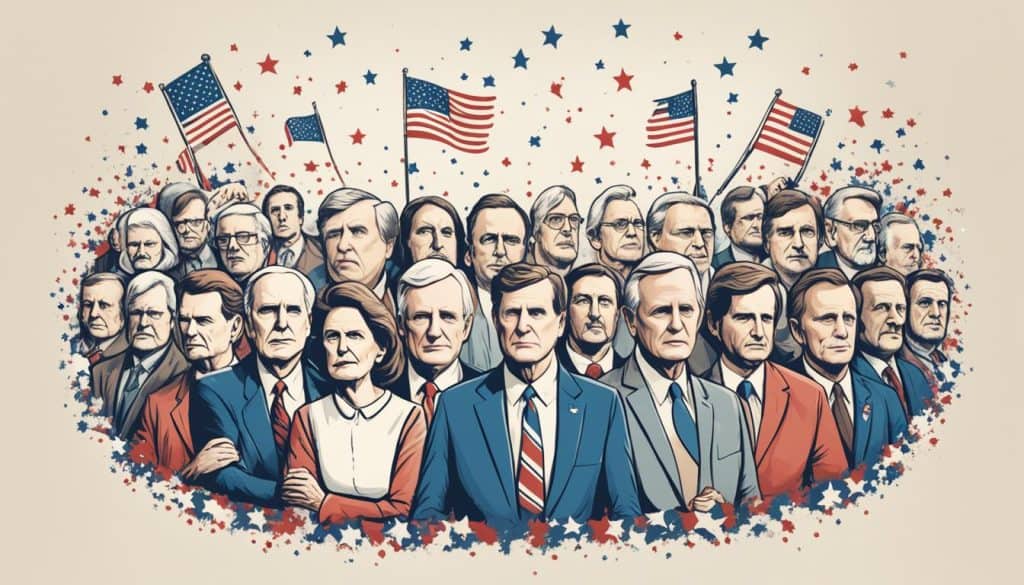
The early tumult of American politics was characterized by the rise of factionalism, an inevitable phenomenon as ideological rifts surfaced within the fledgling government. This period witnessed the birth of American political parties, an outcome that reflected the divergent visions held by the nation’s founders about the direction of the United States.
At the core of this factionalism were two emerging groups: the Federalists, led by Alexander Hamilton, who advocated for a strong central government and a broad interpretation of the Constitution; and the Democratic-Republicans, championed by Thomas Jefferson and James Madison, desiring limited federal authority and strict adherence to the Constitution. These ideological battles were not merely elite contests of philosophy but were grounded in the very structure of the nation’s economy, society, and governance.
The transformation from fluid factionalism to firm party lines was a significant milestone in American history. It was during these formative years that the foundations for America’s party system were laid, precipitating the organized political conflict that would dominate United States politics henceforth.
- Hamilton’s Economic Plan sparked fierce debate, cementing factional lines.
- The French Revolution deepened ideological divides, with American political factions expressing solidarity with different aspects of the European conflict.
- The Alien and Sedition Acts further polarized the young nation, highlighting Constitutional interpretations as a battleground for these emerging factions.
In sum, the birth of American political parties was a natural evolution of factional dispute, growing from heated disagreements on policy and governance into structured organizations that would long influence the trajectory of American democracy. This period serves not only as a fascinating historical account but as a crucial lesson in the dynamics of political alignment and the enduring nature of factionalism within political societies.
The Debate Over Representation: Virginia Plan vs. New Jersey Plan
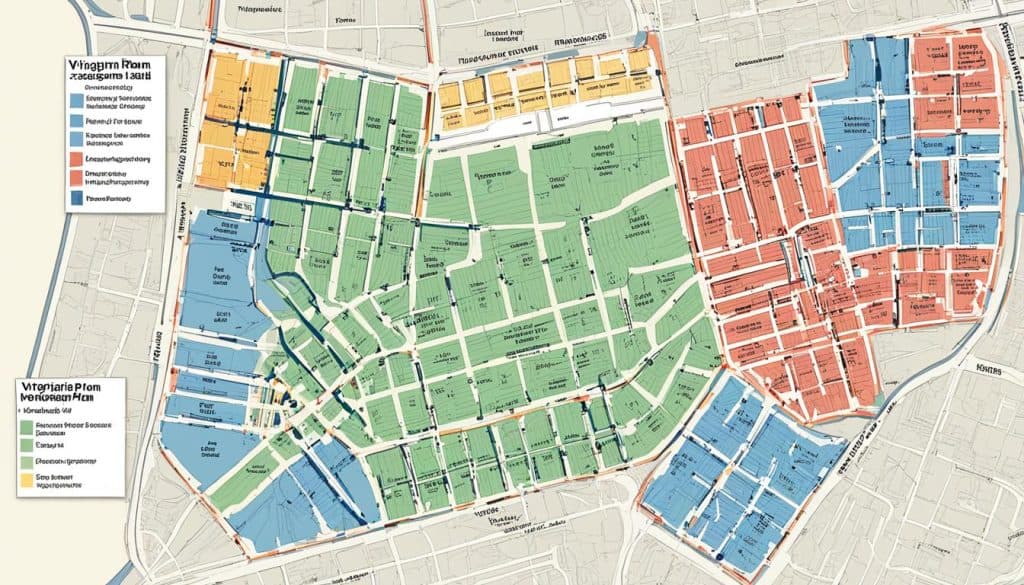
The framing of the United States Constitution was marred by a significant dispute over the nature of representation in the newly formed legislative branch. Two primary proposals emerged: the Virginia Plan and the New Jersey Plan. These plans spotlighted the fundamental tension between states’ desires for sovereignty and the need to establish effective federal powers.
A Struggle for Sovereignty: Balancing State and Federal Powers
The Virginia Plan, favoring larger states, advocated for a bicameral legislature based on population. In contrast, the New Jersey Plan aimed to preserve the concept of state powers, proposing a unicameral legislature with equal representation for each state. This clash necessitated diplomatic finesse to balance the often competing interests of state sovereignty and an authoritative federal government.
The Compromises that Shaped the Legislative Branch
In the shadow of looming disunion, a series of compromises emerged as vital to the formation of the United States’ federal system. The Great Compromise, also known as the Connecticut Compromise, forged the path for a legislative structure that would embody both plans. It established a dual system of representation: a House of Representatives based on population, reflective of the Virginia Plan, and a Senate with equal representation for each state, capturing the essence of the New Jersey Plan. These compromises were crucial in the creation of a legislative branch able to balance federal powers with the rights of the individual states, a balance still at the heart of American governance.
Launching the New Government: Key Legislation and Challenges
As the fledgling United States government embarked on its monumental task of establishing itself, the first Congress faced the significant challenge of launching a functional and cohesive new government. Amidst the enthusiasm of a fresh start, legislators were tasked with passing key legislation that would set the precedent for governance and guide the nation into an era of prosperity and order. This period of initiation was characterized by the creation of foundational policies that would shape the American political landscape for centuries to come.
The nascent administration encountered a myriad of challenges that tested the resilience and adaptability of the new system. Critical to their success was the establishment of a robust financial foundation, which saw the introduction of the Tariff of 1789, aimed at regulating trade and securing revenue. Additionally, statutes such as the Judiciary Act of 1789 laid the groundwork for the federal court system, delineating the authority and structure that would uphold justice across the states. These legislative milestones underscored the importance of innovative and pragmatic governance during the early stages of nation-building.
The journey of the early American government was marked by a steadfast commitment to overcoming obstacles and a dedication to forging a path that future generations would walk upon. The actions taken and the laws passed during this formative period set a trajectory that has since influenced countless facets of public life, demonstrating the enduring impact of those early days of governance. As we reflect on the origins of our nation’s legislative body, it is evident that the tenacity and foresight of the first Congress were instrumental in steering the United States towards a future of democratic stability.
FAQ
What issue divided the first Congress as the nation launched the new government?
The first Congress was divided on the crucial issue of representation and the balance of power between the states and the federal government.
What was the path from the Articles of Confederation to the Constitution?
The path from the Articles of Confederation to the Constitution involved a process of deliberation, drafting, and ratification by the states.
What struggles were faced in ratifying the new framework for governance?
The ratification of the new framework for governance faced challenges such as concerns over the balance of power and arguments over individual liberties.
What was the role of the Federalist Papers in shaping public opinion?
The Federalist Papers were a series of essays written by Alexander Hamilton, James Madison, and John Jay that sought to persuade the public to support the Constitution and its adoption.
How did factionalism contribute to the birth of American political parties?
Factionalism, characterized by ideological differences and divisions among political elites, led to the formation of the first political parties in the United States.
How did the debate over representation unfold between the Virginia Plan and the New Jersey Plan?
The debate over representation in the first Congress centered around the Virginia Plan, which favored a bicameral legislature based on population, and the New Jersey Plan, which advocated for equal representation for all states.
How were struggles for sovereignty and the balance of state and federal powers addressed?
Compromises were reached to balance state sovereignty with federal powers, resulting in the formation of the legislative branch and the establishment of a delicate balance between state and federal authority.
What key legislation and challenges did the first Congress face when launching the new government?
The first Congress had to address various challenges, including establishing a functioning bureaucracy, addressing economic and foreign policy issues, and laying the groundwork for the nation’s future.